Last Wednesday, the 23rd was my 1000th day since arriving in Togo.
Technically, of course, I haven't BEEN here for 1000 days, what with vacation, etc. but still.
It's a number that the vast majority of Peace Corps volunteers don't hit. It's a third year number.
So I decided to celebrate a little. But first I moved furniture for our regional house all day and got really dehydrated, then the owner of the new boite de nuit (nightclub) in Atakpame invited my friend S to come to his restaurant and thanked him for DJing an American night by topping up our beers with Campari.
Not a nice combination, by the way.
Coupled with the delicious chicken burrito with fresh, right-off-the-tree avocado, the beer was a perfect celebratory meal. The chocolate cake with vanilla icing that J made entirely from scratch raised the border above perfection.
It was a lovely way to spend an evening and I'm glad to have hit this milestone.
Have a fun UNITE song to celebrate with me, sung by Club Unite of Datcha. Interested in supporting Camp UNITE this year? check out the Foundation
28 February 2011


19 January 2011
The King and His Three Daughters
Le Roi et ses trois filles
Fiaa de kple evia nyonuvi etoawo
The King and his Three Daughters
Fiaa de kple evia nyonuvi etoawo
The King and his Three Daughters
Traditional story, written down by Yves-Emmanuel Dogbe in “Contes et Legendes du Togo”
Translated and adapted by Rose Lindgren
Once upon a time, there was a king who had three daughters. The daughters were very beautiful but very mysterious. No one in the entire kingdom knew their names. As soon as the daughters grew old enough to be married, offers of betrothal flowed in from every corner of the country from rich men. But the king rejected all of them.
One day, he had all his subjects gather together, both men and animals. “I want to give my daughters in marriage,” he declared to them, “to someone worthy. He who returns in three days time and can tell me the names of my daughters will become my son, husband of my daughters.”
Three days later, men, women, children, animals, all gathered in the courtyard of the royal palace. Beats of the tam-tam and chords of the balafons, the great African music, the true music of our ancestors, filled the air. The king sat down upon his throne, surrounded by his ministers and dignitaries. The three young girls were seated at the feet of their father.
The streets swarmed with crowds, it seemed that every person who had ever heard of the princesses had made the journey to the palace that day. The crowd kept flowing into the courtyard in a never-ending stream.
Once the sun rose to the top of the baobab tree on the horizon, a horn sounded, announcing the opening of the competition. Not even a fly buzzed. Every creature present had searched for three days for the names of the princesses. But no one had been successful. In their failure, they wanted to at least hear the winner reveal the names. Hopeful suitors waited impatiently to the right and to the left of the king, and began to pass in front of him to offer the names they had found or guessed. Each stole glances at the beautiful girls at the king’s feet, hearts bursting with hope of success. But all of the menl failed.
The chance was then given to the animals to try. But Lion, Elephant, Buffalo, Panther, all failed.
Then Hare approached the throne, his large feet padding soundlessly on the packed dirt. The crowd began to throw insults:
“All the respectable men and animals passed through without success,” they cried,”what can we possibly expect of a skinny little hare?”
Everyone murmured, expressing their indignation, ignorant of how sharp a mind the hare had.
And in truth, well before the eve of the trials, Hare had reached an understanding with Turtledove. This bird went and hid herself in a guava tree in the heart of the royal garden where the three sisters loved to play and tease one another, pulling each other’s clothes and long shiny tresses.
The Turtledove perched on a branch directly above them and shook her beak to let a kola nut fall in the middle of the girls. (The princesses were very fond of kola nuts, but they found them only very rarely or not at all.) The girls began to fight and bicker, calling one another by their names. Again Turtledove released a nut, then a third.
The oldest daughter, Lali, had gathered them. She took one for herself, then called over Meyi, the youngest, and gave her one, then called Batsi, the middle child, and gave her the last. The Turtledove noted the three names in the meantime and flew off to confide them to the Hare, who left her the rest of the pile of kola nuts he had gathered. Well, he left her what remained after he had munched on them while he waited, of course.
In front of the king, taking the ministers and dignitaries as witnesses, the Hare revealed the mysterious names. The king tried vainly to hide his despair that he had to take Hare as his son-in-law. But true to his word, he gave his three daughters in marriage to Hare that same day. But the blow to his pride troubled him so severely that he went mad and hung himself only a few days after giving up the throne to Hare and his wives.
The Council of Humans was also very disturbed by the situation. They could not submit to being ruled over by a beast. So they decided to assassinate Hare.
Drunk with the wine of kings and the joy of the marriage bed, Hare was oblivious to the machinations around him. And so, the daughters of the king began to disappear one by one from the household of the Hare who, in turn, was found dead one morning under the talking tree.
Translated and adapted by Rose Lindgren
Once upon a time, there was a king who had three daughters. The daughters were very beautiful but very mysterious. No one in the entire kingdom knew their names. As soon as the daughters grew old enough to be married, offers of betrothal flowed in from every corner of the country from rich men. But the king rejected all of them.
One day, he had all his subjects gather together, both men and animals. “I want to give my daughters in marriage,” he declared to them, “to someone worthy. He who returns in three days time and can tell me the names of my daughters will become my son, husband of my daughters.”
Three days later, men, women, children, animals, all gathered in the courtyard of the royal palace. Beats of the tam-tam and chords of the balafons, the great African music, the true music of our ancestors, filled the air. The king sat down upon his throne, surrounded by his ministers and dignitaries. The three young girls were seated at the feet of their father.
The streets swarmed with crowds, it seemed that every person who had ever heard of the princesses had made the journey to the palace that day. The crowd kept flowing into the courtyard in a never-ending stream.
Once the sun rose to the top of the baobab tree on the horizon, a horn sounded, announcing the opening of the competition. Not even a fly buzzed. Every creature present had searched for three days for the names of the princesses. But no one had been successful. In their failure, they wanted to at least hear the winner reveal the names. Hopeful suitors waited impatiently to the right and to the left of the king, and began to pass in front of him to offer the names they had found or guessed. Each stole glances at the beautiful girls at the king’s feet, hearts bursting with hope of success. But all of the menl failed.
The chance was then given to the animals to try. But Lion, Elephant, Buffalo, Panther, all failed.
Then Hare approached the throne, his large feet padding soundlessly on the packed dirt. The crowd began to throw insults:
“All the respectable men and animals passed through without success,” they cried,”what can we possibly expect of a skinny little hare?”
Everyone murmured, expressing their indignation, ignorant of how sharp a mind the hare had.
And in truth, well before the eve of the trials, Hare had reached an understanding with Turtledove. This bird went and hid herself in a guava tree in the heart of the royal garden where the three sisters loved to play and tease one another, pulling each other’s clothes and long shiny tresses.
The Turtledove perched on a branch directly above them and shook her beak to let a kola nut fall in the middle of the girls. (The princesses were very fond of kola nuts, but they found them only very rarely or not at all.) The girls began to fight and bicker, calling one another by their names. Again Turtledove released a nut, then a third.
The oldest daughter, Lali, had gathered them. She took one for herself, then called over Meyi, the youngest, and gave her one, then called Batsi, the middle child, and gave her the last. The Turtledove noted the three names in the meantime and flew off to confide them to the Hare, who left her the rest of the pile of kola nuts he had gathered. Well, he left her what remained after he had munched on them while he waited, of course.
In front of the king, taking the ministers and dignitaries as witnesses, the Hare revealed the mysterious names. The king tried vainly to hide his despair that he had to take Hare as his son-in-law. But true to his word, he gave his three daughters in marriage to Hare that same day. But the blow to his pride troubled him so severely that he went mad and hung himself only a few days after giving up the throne to Hare and his wives.
The Council of Humans was also very disturbed by the situation. They could not submit to being ruled over by a beast. So they decided to assassinate Hare.
Drunk with the wine of kings and the joy of the marriage bed, Hare was oblivious to the machinations around him. And so, the daughters of the king began to disappear one by one from the household of the Hare who, in turn, was found dead one morning under the talking tree.
06 January 2011
Flitting about the country
I have been running around all over West Africa visiting volunteers and learning and sharing my own experiences. Being a volunteer leader is exhausted and exhilarating at the same time. After two plus years here I really do feel capable of being the ‘wise’ volunteer that can share experiences and enhance a new volunteer’s service.
I went to Senegal for a regional conference of Peace Corps volunteers. Senegal is beautiful, and Dakar is surprisingly well-developed. Dakar is the regional epicenter for all American mission projects. This means that if we need to be medically evacuated for issues that can’t be dealt with in country (anything from broken limbs to root canals) we are often sent to Dakar. It has paved roads! And beautiful expensive restaurants. And, probably most important from the US mission perspective, it has a large airport and excellent medical care facilities.
Luckily for me, I wasn’t there for medical reasons, so I got to explore the fun aspects of the city: taking a ferry out to Goree Island, a heritage site dedicated to remembering the atrocities of the slave trade. An old ‘way station’ where African were kept and breeded before being sent on the perilous journey across the Atlantic, has become a museum.

This picture is of the door on the ocean side of the building, it was known as the ‘point of no return.’ Slaves who crossed this threshold were loaded directly onto boats and either died on the journey or arrived in the New World, never to return to their home.
Many of the locals earn their living from tourism, leading visitors around the island to see the various historical points of interest. Because of its historically sad position, Goree Island was also chosen as a site for a statue that shows the positive moves forward since the days of the slave trade.
The island itself is very beautiful and has become a gathering point for many artisans. One of the artists we encountered made paintings with sand. The sand is not artificially colored – it has all been gathered from various places around West Africa. What a beautiful rainbow of colors!

I found some women artisans making necklaces on the Island and I bought several to send back to you to sell (I kept one for myself too!). The rainbow colors mean peace to the Senegalese. I hope that the students love them as much as I do.
After Dakar, I didn’t have any rest before heading straight up to the northernmost region of Togo. Well, that’s not true. I had an extra day to be in Dakar, due to the political violence and civil unrest in Cote d’Ivoire. We were supposed to have a layover in Cote d’Ivoire, but the elections proved to be very contentious and the former president, who has been in office for 10 years (he put off the election for 5 years) is violently trying to retain control of the presidency even though the United Nations supports the other candidate as having gained the majority of votes. In any case, the violence and instability made it impossible for us to keep our original flight plan, so we were rerouted through Mali and arrived in Togo on Monday.
On Tuesday, I headed up to Dapaong, the regional capital of the Savannah region, the driest and poorest region of Togo. It is currently the season of Harmattan, when the wind blows down from the Sahara, carrying along dust clouds that blot out the sun, making it dry and dusty and surprisingly cold, especially at night.
I was in the Savannah region for a couple different reasons. First, we had our quarterly Gender and Development committee meeting and, as a coordinator for the Karren Waid Scholarship Program, I am a member. I had great new for them: I sold all of the bags and aprons that I brought with me to Senegal and the volunteers there want more! The funds we raise from selling these items not only go to the artisans who make them, but also to fund small community projects that have to do with gender. For example, we helped a group of women buy 8 goats, so that they could raise them and breed them so that they could learn how to raise animals, manage money, and save money so they could send their daughters to school whether or not their husband wanted to. In Togo, many girls do not go to school at all, and many others only go to primary school. Once they reach the junior high level, their parents often want them to stay at home to take care of the babies or else help them in the fields or at the market, selling products. It can take a lot of convincing to get a family to continue to send their girls to school. It helps if we can support the mothers to make enough money to pay the school fees.
School fees are not very expensive in dollars – only 7 dollars per year. (3500 FCFA) but this is enough money to feed a family for a week, so it can make a huge dent in the pocket of a family that earns about a dollar a day.
I picked up some gorgeous napkins and tablecloths made by the weaver’s collective in Dapaong and sent some to California. They are all made by hand by a cooperative group, staffed mostly by women, who have been weaving since they were children.

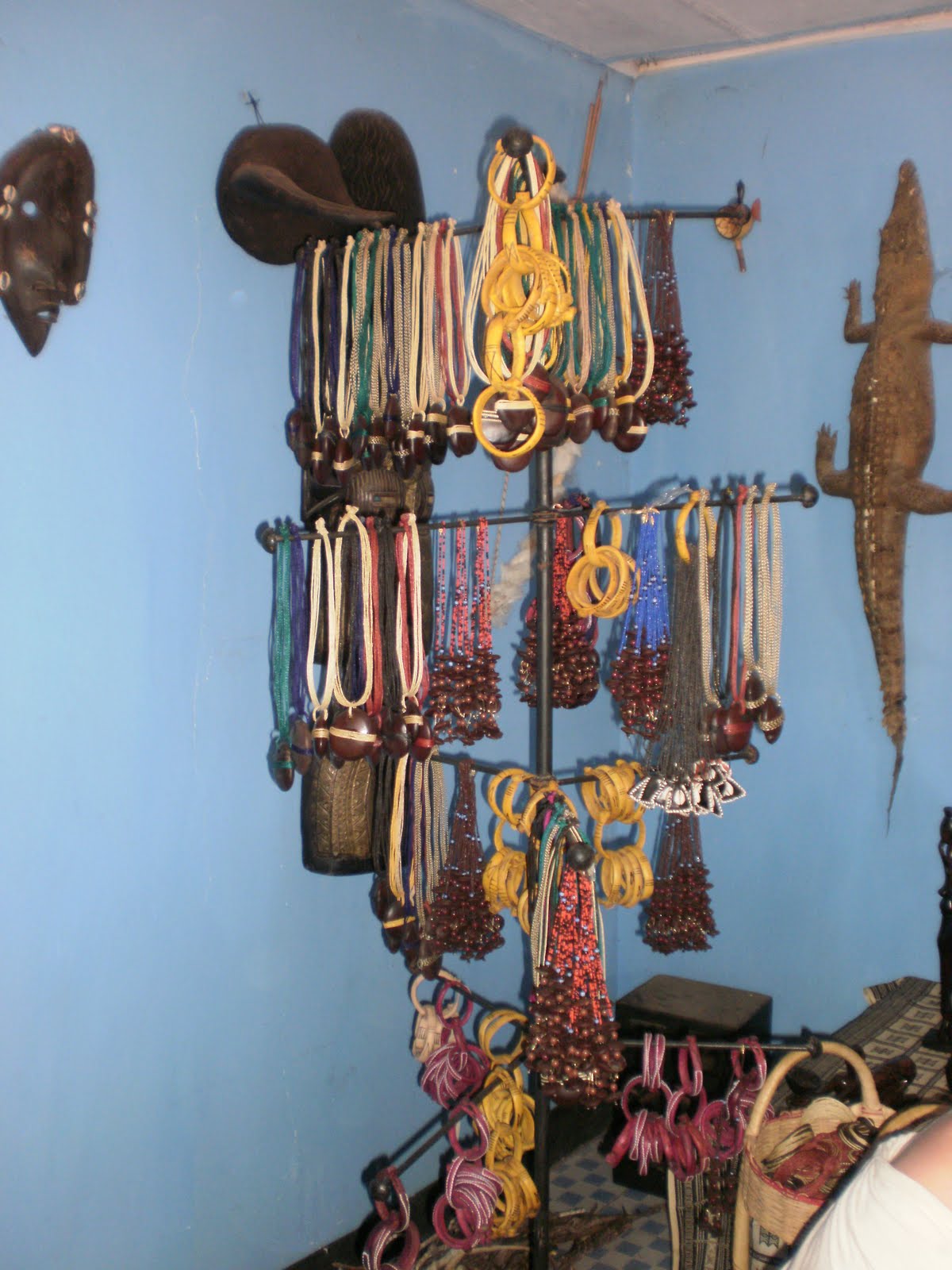
As well as some necklaces and bracelets from a local artisan shop run by a man who goes around to tiny villages and buys the handicrafts made there and brings them into the big city where the handicrafts can find a better audience.
Another reason I was in the Savannah region was to visit the five new volunteers that have just taken up their posts. They had their ‘swearing-in’ ceremony in mid-November, so they had only been in their posts for a few weeks. I was stopping by to see how their community integration, language learning, etc. were going and answer any questions they had.
In visiting the various volunteers, I drank a lot of tchakpa, the local fermented millet drink. It’s like beer, and is a staple drink for everyone who lives in the Savannah region. I liken it to the pilgrims on the Mayflower, who drank beer because they couldn’t trust the water to be free of parasites. The boiling and fermentation process helps to rid the liquid of bacteria, etc.
We drink it out of calabash halves – like a big gourd. They are commonly used as bowls, cups, even spoons (when broken or cut in half).
In one village, I got a real treat! A local ‘Starbucks’.
By which I mean, a guy who puts sweetened condensed milk and dehydrated coffee (Nescafe) into a cup and adds boiling water. It’s delicious. And only 100CFA (less than 25 cents)
The Savannah region is characterized by flat fields (dry and brown in this dry and cold season) punctuated by huge baobab trees.

It is a gorgeous landscape.
The third reason I was in the region was to take advantage of the local historical tourist site: the caves of Nano. These caves were used by the Moba people in their war with the Tchokossi people. They are located about 20 feet from the top of a cliff, making them excellent places from which to survey the land and, using their bows and arrows, take down opponents trying to scale the cliff and reach their mountain-top settlements.
There is a spring that comes straight out of the rock – what a miracle! Women still use this spring to gather drinking water – it is pure and clean from parasites unlike the river water they would otherwise be gathering.
The best thing about the Savannah region is the people. Even though I couldn’t speak any of their local languages (Moba, Tchokossi, Gamgam) I still felt warmly welcomed.

I went to Senegal for a regional conference of Peace Corps volunteers. Senegal is beautiful, and Dakar is surprisingly well-developed. Dakar is the regional epicenter for all American mission projects. This means that if we need to be medically evacuated for issues that can’t be dealt with in country (anything from broken limbs to root canals) we are often sent to Dakar. It has paved roads! And beautiful expensive restaurants. And, probably most important from the US mission perspective, it has a large airport and excellent medical care facilities.
Luckily for me, I wasn’t there for medical reasons, so I got to explore the fun aspects of the city: taking a ferry out to Goree Island, a heritage site dedicated to remembering the atrocities of the slave trade. An old ‘way station’ where African were kept and breeded before being sent on the perilous journey across the Atlantic, has become a museum.

This picture is of the door on the ocean side of the building, it was known as the ‘point of no return.’ Slaves who crossed this threshold were loaded directly onto boats and either died on the journey or arrived in the New World, never to return to their home.
Many of the locals earn their living from tourism, leading visitors around the island to see the various historical points of interest. Because of its historically sad position, Goree Island was also chosen as a site for a statue that shows the positive moves forward since the days of the slave trade.

The island itself is very beautiful and has become a gathering point for many artisans. One of the artists we encountered made paintings with sand. The sand is not artificially colored – it has all been gathered from various places around West Africa. What a beautiful rainbow of colors!


I found some women artisans making necklaces on the Island and I bought several to send back to you to sell (I kept one for myself too!). The rainbow colors mean peace to the Senegalese. I hope that the students love them as much as I do.
After Dakar, I didn’t have any rest before heading straight up to the northernmost region of Togo. Well, that’s not true. I had an extra day to be in Dakar, due to the political violence and civil unrest in Cote d’Ivoire. We were supposed to have a layover in Cote d’Ivoire, but the elections proved to be very contentious and the former president, who has been in office for 10 years (he put off the election for 5 years) is violently trying to retain control of the presidency even though the United Nations supports the other candidate as having gained the majority of votes. In any case, the violence and instability made it impossible for us to keep our original flight plan, so we were rerouted through Mali and arrived in Togo on Monday.
On Tuesday, I headed up to Dapaong, the regional capital of the Savannah region, the driest and poorest region of Togo. It is currently the season of Harmattan, when the wind blows down from the Sahara, carrying along dust clouds that blot out the sun, making it dry and dusty and surprisingly cold, especially at night.
I was in the Savannah region for a couple different reasons. First, we had our quarterly Gender and Development committee meeting and, as a coordinator for the Karren Waid Scholarship Program, I am a member. I had great new for them: I sold all of the bags and aprons that I brought with me to Senegal and the volunteers there want more! The funds we raise from selling these items not only go to the artisans who make them, but also to fund small community projects that have to do with gender. For example, we helped a group of women buy 8 goats, so that they could raise them and breed them so that they could learn how to raise animals, manage money, and save money so they could send their daughters to school whether or not their husband wanted to. In Togo, many girls do not go to school at all, and many others only go to primary school. Once they reach the junior high level, their parents often want them to stay at home to take care of the babies or else help them in the fields or at the market, selling products. It can take a lot of convincing to get a family to continue to send their girls to school. It helps if we can support the mothers to make enough money to pay the school fees.
School fees are not very expensive in dollars – only 7 dollars per year. (3500 FCFA) but this is enough money to feed a family for a week, so it can make a huge dent in the pocket of a family that earns about a dollar a day.
I picked up some gorgeous napkins and tablecloths made by the weaver’s collective in Dapaong and sent some to California. They are all made by hand by a cooperative group, staffed mostly by women, who have been weaving since they were children.


As well as some necklaces and bracelets from a local artisan shop run by a man who goes around to tiny villages and buys the handicrafts made there and brings them into the big city where the handicrafts can find a better audience.
Another reason I was in the Savannah region was to visit the five new volunteers that have just taken up their posts. They had their ‘swearing-in’ ceremony in mid-November, so they had only been in their posts for a few weeks. I was stopping by to see how their community integration, language learning, etc. were going and answer any questions they had.
In visiting the various volunteers, I drank a lot of tchakpa, the local fermented millet drink. It’s like beer, and is a staple drink for everyone who lives in the Savannah region. I liken it to the pilgrims on the Mayflower, who drank beer because they couldn’t trust the water to be free of parasites. The boiling and fermentation process helps to rid the liquid of bacteria, etc.

We drink it out of calabash halves – like a big gourd. They are commonly used as bowls, cups, even spoons (when broken or cut in half).
In one village, I got a real treat! A local ‘Starbucks’.

By which I mean, a guy who puts sweetened condensed milk and dehydrated coffee (Nescafe) into a cup and adds boiling water. It’s delicious. And only 100CFA (less than 25 cents)
The Savannah region is characterized by flat fields (dry and brown in this dry and cold season) punctuated by huge baobab trees.


It is a gorgeous landscape.
The third reason I was in the region was to take advantage of the local historical tourist site: the caves of Nano. These caves were used by the Moba people in their war with the Tchokossi people. They are located about 20 feet from the top of a cliff, making them excellent places from which to survey the land and, using their bows and arrows, take down opponents trying to scale the cliff and reach their mountain-top settlements.

There is a spring that comes straight out of the rock – what a miracle! Women still use this spring to gather drinking water – it is pure and clean from parasites unlike the river water they would otherwise be gathering.

The best thing about the Savannah region is the people. Even though I couldn’t speak any of their local languages (Moba, Tchokossi, Gamgam) I still felt warmly welcomed.

20 December 2010
more pictures from savannes region
Ah! I get it now.

Kids and Cows

Tchakpa lady

Tchakpa mustache

Ritual site overlooking city of Dapaong

A natural spring in a cliff in the middle of the dryest part of the country.

The griot.

The reason for the seasoning?

"The corner office can wait, some corners of the world can't"


Kids and Cows

Tchakpa lady

Tchakpa mustache

Ritual site overlooking city of Dapaong

A natural spring in a cliff in the middle of the dryest part of the country.

The griot.

The reason for the seasoning?

"The corner office can wait, some corners of the world can't"

Site visits
Site visits blog
Dear C,
Thank you so much for having me over to see your village. I enjoyed visiting your market and indulging in ‘Starbucks’ à la villageoise. It’s rare to find another eldest child from a big family here, so it was fun to connect and chat about our siblings. Good luck in your first few months exploring the assets and needs of your village. I included info on village savings and loans, income-generating activities and funding applications on the USB key; I hope you’ll find them very useful.

Dear J,
Thank you for hosting me for a day in your village. I had a lot of fun wandering around the tchakpa stands and through the fields. Congratulations on taking such a strong interest in learning local language and integrating with an eye for finding really relevant work. I still haven’t tried ‘flea’ yet - maybe next time. I included some information on appropriate technology and income-generating activities that I hope will be useful. I look forward to working with you to plan workshops at the new maison.

Dear D and C,
Thank you ever so very much for taking me in for a few days as I journeyed in and around Dapaong. I love your house but even more your company and I hope that you will take advantage of my new digs any time you stop in Atakpame. I hope you have (well, had, by the time you receive this) a fantastic time in Germany. Thanks for your support as well through my Senegal ‘revelation’. It has now become a new jumping-off point and I’m getting excited about choosing a US city and forging ahead with a slightly changed destination but still the same stubborn drive to ‘save the world’ wherever I can.

Dear D,
Thank you so much for hosting me and taking me up to the caves. I can’t believe you hiked up that mountain twice in two days. You are going to be the fittest volunteer in country! I have to admit, I’m still thinking about that chilli too! I think I might make it for Christmas dinner. It was really yummy. Well, have a lovely December. Make sure to check out the resources I put on the USB key and put on any that you’ve inherited or created. I don’t mind duplicates, so throw on whatever you’ve got PS Just read your story for Perspectives. It was lovely. Please write more!

Dear H,
Thank you so much for hosting me in your beautiful little village. I enjoyed getting soaked gathering water, being serenaded by blind griots, gathering seeds and just chatting. I’m really excited about your village’s enthusiasm. I hope you have a great time making friends, planting trees and discovering your projects as they emerge naturally out of the contacts you have and will make. I hope you’ll find the resources I put on the USB key to be useful. Let me know if there’s anything I can send up.

Dear E,
Thank you so much for hosting me in your itsy bitsy village. I loved taking a walk around to see those beautiful gardens. What an exciting start for an NRM volunteer to already have people who know how to garden and make use of what little water there is available. I’m glad to see you’ve got a host family that’s ready to get things done for you - a porch in two days? Amazing. I’ve put a couple things on teaching English on the key I sent to Dapaong, but Joe is still at work on the full guide. Hopefully it can give you at least a couple of ideas. I hope you have a lovely Christmas and that the phone lines are nice and strong for you to keep in touch with everyone back home too!

Dear E,
Thank you so much for hosting me at your house. It was really interesting to be there on the day that they chose the new regent chef de canton. Good luck appreciating the benefits of having French translation available to you while navigating the pitfalls of being associated with the Kabye outsiders. I enjoyed chatting with you, I hope we didn’t offend your village too much by not wanting to hang out with all the dudes at the bar. Thanks so much for setting me up with a moto to get back to Mango. Have a great Christmas

Dear C,
Thank you so much for having me over to see your village. I enjoyed visiting your market and indulging in ‘Starbucks’ à la villageoise. It’s rare to find another eldest child from a big family here, so it was fun to connect and chat about our siblings. Good luck in your first few months exploring the assets and needs of your village. I included info on village savings and loans, income-generating activities and funding applications on the USB key; I hope you’ll find them very useful.

Dear J,
Thank you for hosting me for a day in your village. I had a lot of fun wandering around the tchakpa stands and through the fields. Congratulations on taking such a strong interest in learning local language and integrating with an eye for finding really relevant work. I still haven’t tried ‘flea’ yet - maybe next time. I included some information on appropriate technology and income-generating activities that I hope will be useful. I look forward to working with you to plan workshops at the new maison.

Dear D and C,
Thank you ever so very much for taking me in for a few days as I journeyed in and around Dapaong. I love your house but even more your company and I hope that you will take advantage of my new digs any time you stop in Atakpame. I hope you have (well, had, by the time you receive this) a fantastic time in Germany. Thanks for your support as well through my Senegal ‘revelation’. It has now become a new jumping-off point and I’m getting excited about choosing a US city and forging ahead with a slightly changed destination but still the same stubborn drive to ‘save the world’ wherever I can.

Dear D,
Thank you so much for hosting me and taking me up to the caves. I can’t believe you hiked up that mountain twice in two days. You are going to be the fittest volunteer in country! I have to admit, I’m still thinking about that chilli too! I think I might make it for Christmas dinner. It was really yummy. Well, have a lovely December. Make sure to check out the resources I put on the USB key and put on any that you’ve inherited or created. I don’t mind duplicates, so throw on whatever you’ve got PS Just read your story for Perspectives. It was lovely. Please write more!

Dear H,
Thank you so much for hosting me in your beautiful little village. I enjoyed getting soaked gathering water, being serenaded by blind griots, gathering seeds and just chatting. I’m really excited about your village’s enthusiasm. I hope you have a great time making friends, planting trees and discovering your projects as they emerge naturally out of the contacts you have and will make. I hope you’ll find the resources I put on the USB key to be useful. Let me know if there’s anything I can send up.

Dear E,
Thank you so much for hosting me in your itsy bitsy village. I loved taking a walk around to see those beautiful gardens. What an exciting start for an NRM volunteer to already have people who know how to garden and make use of what little water there is available. I’m glad to see you’ve got a host family that’s ready to get things done for you - a porch in two days? Amazing. I’ve put a couple things on teaching English on the key I sent to Dapaong, but Joe is still at work on the full guide. Hopefully it can give you at least a couple of ideas. I hope you have a lovely Christmas and that the phone lines are nice and strong for you to keep in touch with everyone back home too!

Dear E,
Thank you so much for hosting me at your house. It was really interesting to be there on the day that they chose the new regent chef de canton. Good luck appreciating the benefits of having French translation available to you while navigating the pitfalls of being associated with the Kabye outsiders. I enjoyed chatting with you, I hope we didn’t offend your village too much by not wanting to hang out with all the dudes at the bar. Thanks so much for setting me up with a moto to get back to Mango. Have a great Christmas

06 December 2010
return from Senegal
Dakar is amazing.
According to our standards as Togo volunteers, Accra Ghana is 'like America'
Not even close.
Dakar on the other hand...

So I wasn't too annoyed at the political swirlings currently underway in Cote d'Ivoire that threatened the possibility of return to Togo. I thought perhaps we would end up staying a few extra days in the country. I would almost certainly spend ridiculous amounts of cfa, but it's a sacrifice I'm willing to make for real ice cream and Indian food.
But the proposed flight change for Air Ivoire involved flying into Abidjan on Sunday. And then flying from Abidjan to Togo on Monday. Over 24 hours in the capital city of a country that's not doing very well at the moment.
Luckily, Peace Corps is brilliantly set up and placed for this kind of situation and my colleague and I were able to ask Peace Corps Senegal to coordinate with Peace Corps Togo. They found us a new flight home - through Bamako, Mali, not Abidjan, Cote d'Ivoire. We have arrived safe and sound and with all of our baggage intact. Hoorah.
According to our standards as Togo volunteers, Accra Ghana is 'like America'
Not even close.
Dakar on the other hand...

So I wasn't too annoyed at the political swirlings currently underway in Cote d'Ivoire that threatened the possibility of return to Togo. I thought perhaps we would end up staying a few extra days in the country. I would almost certainly spend ridiculous amounts of cfa, but it's a sacrifice I'm willing to make for real ice cream and Indian food.
But the proposed flight change for Air Ivoire involved flying into Abidjan on Sunday. And then flying from Abidjan to Togo on Monday. Over 24 hours in the capital city of a country that's not doing very well at the moment.
Luckily, Peace Corps is brilliantly set up and placed for this kind of situation and my colleague and I were able to ask Peace Corps Senegal to coordinate with Peace Corps Togo. They found us a new flight home - through Bamako, Mali, not Abidjan, Cote d'Ivoire. We have arrived safe and sound and with all of our baggage intact. Hoorah.
28 November 2010
TIA
So. I should be in the air right now, on my way to yet another adventure. But, TIA. This is Africa.
I am sitting back on the computer in Lome.
I took a taxi to the airport this morning at 3.30am (paying more than
my night in the hotel, of course) and was greeted with a hand-written
note on the doors saying that my flight had been cancelled.
I had a connecting flight in Abidjian and the borders have been closed
because of the election. I spoke to someone who said that I will be
able to get onto the flight tomorrow morning, but I don't have a
guarantee. The Air Ivoire website is currently showing tomorrow's
flight as full.
Boo hoo hoo. I want my vacation!
I am sitting back on the computer in Lome.
I took a taxi to the airport this morning at 3.30am (paying more than
my night in the hotel, of course) and was greeted with a hand-written
note on the doors saying that my flight had been cancelled.
I had a connecting flight in Abidjian and the borders have been closed
because of the election. I spoke to someone who said that I will be
able to get onto the flight tomorrow morning, but I don't have a
guarantee. The Air Ivoire website is currently showing tomorrow's
flight as full.
Boo hoo hoo. I want my vacation!
27 November 2010
more wandering in my quartier
Local version of see-saw  Tchouk/tchakpa/wandering buddies
 And dancing kids
 Tchouk/tchakpa/wandering buddies
 And dancing kids
Quick visit to Mission Tove
I popped over to Mission Tove for a brief visit and snapped a couple shots of the cistern.
Unfortunately, the kids haven't really started doing the hand-washing thing but at least they have water.
Petit a petit, l'oiseau fait son nid.


Unfortunately, the kids haven't really started doing the hand-washing thing but at least they have water.
Petit a petit, l'oiseau fait son nid.


Mon quartier
I've been wandering around my neighborhood, getting to know people.
Here are some photos to enjoy.
A boy in charge of keeping an eye on the tchakpa (a fermented millet drink, this version is recipe from la region des Savannes, the northernmost region of Togo)

A traditional healer using herbs and massage to take care of people's injuries and broken bones.


Kittens and babies - cute the world over


Here are some photos to enjoy.
A boy in charge of keeping an eye on the tchakpa (a fermented millet drink, this version is recipe from la region des Savannes, the northernmost region of Togo)

A traditional healer using herbs and massage to take care of people's injuries and broken bones.


Kittens and babies - cute the world over


Subscribe to:
Posts (Atom)