Showing posts with label Peace Corps. Show all posts

26 March 2015

Camp UNITE .... in Arabic

In class, we've been working on short presentations on health, the environment, and education for the past few weeks. So one of my chosen topics was Camp UNITE. I recorded myself and added some photos from past years in order to make it more interesting. and voila!

Enjoy!


And please note that The UNITE Foundation is hosting a very exciting event on May 9th to celebrate the start of a new Camp UNITE in 2015 and to gather all of our supporters together to have some fun. Stay tuned for more information.

EDIT:  Just listened to this again and found 3 grammatical errors in the first sentence. oh well! It's the effort that counts, right? My apologies to anyone who actually speaks Arabic!

26 January 2012

A wee summary


A few days, or possibly weeks ago, an alumna from my high school emailed me, wanting to know more about going into the Peace Corps. I wrote up this summary and figured it would be a good way to get back into posting on my blog as well.

When our alumni director interviewed me, she asked me whether our high school had influenced my choice to go into the Peace Corps. I had a hard time articulating that in the moment, but it certainly did. Choosing to serve requires an immense amount of self-confidence and a belief that one single person CAN make a difference. I know that the supportive environment, both teachers and other students, at our high school nurtured those qualities in me. I'm not surprised that another alumna is looking for a way to 'give back.'

Let me just say, if you are considering doing service in international development, I believe that Peace Corps is the best option available. The training and support you receive and the huge emphasis on project management, cultural integration, and community-initiated work is a unique blend. Too many other volunteer opportunities focus on one thing - like cultural exchange, where they send volunteers to an area, they do a cookie-cutter project like building houses, eat a few meals with a host family, and then go home. In the Peace Corps, you arrive in your village and spend the first six months doing a participatory needs assessment, learning what your community is good at, how they celebrate grand occasions, how they mourn loss, and what they want to do to improve their own lives. Then you develop ideas and projects hand-in-hand with your local counterparts. It's slower and you will work harder than in other projects, but in the end, you have personally learned a huge number of skills in project management and design, skills that you wouldn't have had exposure to in the workplace in America for several years. And your unique integration with the community, positive identification of their resources (human, plant, animal, financial) allows your community itself to find the strength to not only be successful with you, but also to continue the work after you've left.


I spent three years in Togo, in West Africa. I went in as a Small Enterprise Development volunteer with an emphasis in Non-Profit Development. The following summary is only the bare bones of the work that I did, I recommend you take a look at other entries on my blog for a fuller picture.
A short video I used in a presentation
I spent most of my first year doing projects in my tiny no-electricity-no-running-water village, working with a local seamstress to build up her business and then, through her, teaching apprentice seamstresses and tailors basic business skills. My second year, I took on managing and running a national youth leadership camp, recruiting camp counselors and young people from all over Togo to learn skills from the personal - self-confidence, to the practical - puberty and adolescence, to the social - how to prevent HIV/AIDS and teach others to prevent it too. I took on a third year of service (service is normally only 2 years) because I had the opportunity to take on a leadership role in the volunteer community, helping to improve training and support for volunteers. In addition to supporting volunteers, I was able to continue the community projects I'd taken on, bringing them to the next level - re-establishing a scholarship program for girls with a US-based foundation to support them, and starting to put together monitoring and evaluation techniques for the youth leadership camp that would enable us and our funders to better attract donations.

As you can see, I did a lot of interesting work - from grant-writing to building a gigantic walk-through uterus to help kids understand how menstruation and pregnancy work. I participated in tons of community events - from a convoluted traditional engagement ceremony that started with a 45 minute hike up a mountain to joining the local church choir (trying as best I could to sing along in the local language Ewe).

It was at times tough and tear-your-hair-out frustrating, but I am so happy that I did it. I am very proud of the work that I did, blessed by the friendships I made, and profoundly changed by the challenges I faced.

I strongly encourage you to apply to the Peace Corps - keep in mind that the application process itself took a year for me, and that's pretty typical, so go into it with patience and flexibility.

02 August 2011

the passing of a friend

My friend Jean, the local traditional healer and the first guy in Atakpame to invite me to share a meal with his family, just died.

Here are a few pictures of him, in memory.


26 July 2011

Camp UNITE Eleves Garcons

23 July 2011


So the boy students all left this morning. I got to be a counselor this week! This picture is of my cabin counselors – Irenee and Peter. Irenee just finished his first year at university and he has been involved in Camp UNITE since 2008, when he was participant. In 2009 and 2010, he played the role of “Pagi”, a character that dresses up in bizarre clothes and incites the participants into explaining the things they’ve learned each day so that they can win back a plank on the “bridge to a healthy life.”


Peter is our “Young Leader”, a former participant who has done a lot of work in his village with a peer educator club who has come back to tell his story and encourage the current participants to keep working when they return to village.
We were the counselors for the cabin Anaconda. We made up all sorts of songs and dances as “king of the river”. Brilliant.

I also facilitated a session with another counterpart, Honoré, on Adolescence and Reproduction. It was awesome because I got to do the tour of the walk-through female reproductive system. (The second picture we’re inside the uterus) What started out as a crazy idea has really proven its worth. Both the participants and the other counselors (several of whom are science teachers) loved the model. They found it really easy to understand. Plus it’s fun!

27 May 2011

It's not an easy road


Fridays are always a busy day for the organizers in charge of logistics at Camp UNITE.
One of the best things about camp is the chance to get young people and Togolese professionals together from all over the country.
But it can also be a logistical nightmare.
Trying to figure out how many cars we need to rent, bargaining with the taxi trade association, handing out extra transportation money…
With our budget constraints we can’t rent whole cars, we pay per place in the cars, which means we have to rely on the drivers to be nice and willing to be flexible. This takes some convincing (and sometimes extra t-shirts to make them happy).
And the participants and counselors that go all the way north… They have the toughest time. The drivers pretty much refuse to go north of Kara (which is the capital city of the region of Kara). It’s another 3 hours to get to the capital city of the region of Savannes, north of Kara, and we have to figure out a way to get everyone all the way there.
Transportation in Togo is not like transportation in the developed world. There is literally one 2-lane highway that runs up the center of the country. With the lack of infrastructure and capital, the government has never made the investment to ensure the durability of the road. Someone explained to me that major highways in the states are about 3 feet thick- layers of gravel and asphalt that getter finer as they reach the surface, with a final layer of tar to get it all to stick together.

In Togo, they wet the dirt and press it down.

Okay, there are some places where there’s a few inches of gravel and a layer of asphalt and tar. But the rainy season seeps through those few inches, erodes away the dirt, and creates potholes larger than the overloaded trucks.
It’s a tough road. It requires patience, good humor and a strong commitment to arriving at your destination.

Today we talked about objectives and leadership. An apprentice who participated in camp last year came back this year as a jeune leader. He explained that when he arrived back home, he had a tough time explaining to his community what he had learned at camp.
“My mother asked me for the money that I had gotten at camp. I tried to explain that I didn’t receive money, I received information. She didn’t understand. So I set my alarm for really early in the morning and I got up before my mother and I started sweeping the compound. She woke up and saw me and she laughed at me. She thought that I was just really excited about camp and would give it up soon. But I didn’t. I set my alarm early every morning and I get up and I sweep. She understands now that what I received is more valuable than money.”
Trying to change gender roles in Togo is very difficult – girls and women are in charge of sweeping, cleaning, cooking food, gathering water. This means that girls have less time to study for school, are late going to their apprenticeships, and don’t have the time to do income-generating activities.
This is why it is so important to get young men to take responsibility for gender equity. Without the buy-in and active participation of young men, young women cannot succeed.
The young men who participate in the camp for boy apprentices emerge as young leaders. With patience, good humor and persistence, they can start down the road to change people’s ideas and behaviors.

Want to try out some activities that engage men in gender equity and community change? Check out Engender Health’s Men As Partners curriculum. It’s a fantastic resource that we’ve integrated into our work at Camp Unite.

Donate to The Unite Foundation – we’ve still got $3000 more to raise before student camps in July!


Camp UNITE! pics


Self-Confidence


Confiance en soi
Self-Esteem and Confidence

Through Camp Unite, I learned many new things that have transformed me into a new man. Why do I say that? Because at the training of trainers for the Camp, I doubted that I could succeed at the theme “Gender Equity” because it is so complex. But after we were introduced to the theme “Self-Confidence”, I became determined and my doubts disappeared and with courage I was able to present this difficult theme from start to finish successfully.
And so, I encourage all of you readers: men, women, boys and girls to have confidence in yourselves in all the circumstances in the world. There is nothing that is impossible.
Paul, Counselor at Camp UNITE - farmer from Zafi in the Maritime Region

I noticed in my community in Gando that many young people don’t have confidence in themselves, the key to success. Because we think that the best things will come to us if someone else gives them to us. But if we have confidence, we ourselves can succeed because there’s nothing in this world that is difficult impossible. It’s especially our girls that don’t have confidence
Seraphin, apprentice tailor from Gando in the Savannah region

Self-confidence is a good thing that every individual should have in their life. Without self-confidence a woman cannot accomplish a goal. Without self-confidence there isn’t a healthy life. All things are possible in life, ‘vouloir c’est pouvoir’ (‘where there’s a will there’s a way’). For that, I will encourage my fellow apprentices to hold on to their self-confidence in order to accomplish their objectives. In life, you have to face problems before you can win.
Brigitte, apprentice dressmaker from Tigbada in the Central region

You must practice self-confidence to speak in groups. I was too embarrassed to even speak at the dinner table. But Camp Unité made me get self-confidence and I know I can cross the bridge to a healthy life.
Factors of self-confidence:
Speak in public
Take strong decisions
Courage and concentration
Repeat each day “I can and I will”
SATSI Videva Tchifama


I speak to you about “self-confidence” which is to have the courage that your yes is yes and your no is no. You should share your ideas with others. I participated in Camp Unité 2011 in Pagala and I learned many things that I found interesting, especially “self-confidence.” I like that theme because before I was ashamed to speak in public. If you are in the same position as me, you must have self-confidence and have the courage to speak in public. Don’t lower your head. Thanks to the US Embassy.
DOTSE Kokou Ali, EPP Lonvo

26 May 2011

A guest speaker

"We hung on to the side of the truck and the girls were inside. After three days one of the boys fell off the truck and was crushed by the wheels. We buried him under the leaves but couldn’t stay for long.”
Every week at Camp UNITE, the participants get to meet a young person from Pagala, the village where we hold camp, who has been trafficked. It is devastatingly easy to find a speaker.
Today’s speaker’s name is Kossi. He was first trafficked when he was still a student, in about 7th grade. A man from Nigeria arrived in the village, driving a new motorcycle and offering jobs to strong young men and women. The man handed Kossi a 1000 FCFA bill (worth about 2 dollars, more than the average daily wage). Kossi didn’t like that he had to share a room at home and that he couldn’t afford to buy jeans and t-shirts like his friends. So he snuck out of his house and lied to his friends and family so he could join the bus of Togolese young people on their way to Nigeria.
The quote above describes only the journey. The months Kossi and his other companions worked in the fields were worse. They walked 15 km in the dark out to the fields to start work at 3am. Field work continued until dark at 6pm when the workers were allowed to make themselves food, many of them had not eaten all day.
“When it rained, we had to keep working. We didn’t have anywhere to take shelter or any way to get dry, so we just took off our clothes and buried them in the ground to keep them dry. And we kept working.”
As awful as his experience was, Kossi went back the next year. And the year after. He explained that the money was addictive. He would return with a lot of money, nearly 200 dollars, but then spend it all in a week as he made his way home.
And so he would go back, telling himself that this time he would find a way to save the money. Each time it was like Russian Roulette, he never knew whether he would survive the journey or die like the 4 friends that he buried.
The participants at Camp UNITE for apprentice boys are not young. Some of them are even older than me! They make decisions for themselves and have responsibility for their own homes. We are not worried that they would be sold by parents to unscrupulous traffickers.
Trafficking in persons is not that simple. Sometimes the person makes the choice for themselves. The Trafficking Victims Protection Act defines severe forms of trafficking as:

a. Sex trafficking in which a commercial sex act is induced by force, fraud, or coercion, or in which the person induced to perform such an act has not attained 18 years of age; or

b. The recruitment, harboring, transportation, provision, or obtaining of a person for labor or services, through the use of force, fraud, or coercion for the purpose of subjection to involuntary servitude, peonage, debt bondage or slavery.

It’s clear that these young men were recruited and transported based on a fraudulent idea of how much money they would gain and how hard/life-threatening the work would be. They were then subjected to debt bondage and near slavery.
But the borders are so porous and the ability to find and prosecute traffickers is so limited, that the state has very little it can accomplish. There are no services available for young men from 15-24 years old. This type of indentured labor will not be eradicated until both the state and social services have sufficiently developed.
The young men must also be able to earn a sufficient wage in country. Kossi’s story ended well, but not because of any money he earned in Nigeria. He explained
“I started to save my money. I learned to cook for myself so I didn’t have to buy prepared food. When I saved enough, I bought phone cards to resell. Each time I made a profit, I learned to save it and invest in my business. Now I have a small shop where I sell gas to moto drivers and phone cards. None of this money was from Nigeria. It was all from my earnings in Togo. You can do it here, but you have to make plans and budgets.”


Donate to the Unite Foundation
unitefoundation.org

24 May 2011

Camp UNITE!

To the tune of ‘Down by the Bay’
Au Camp Unité
Pour les jeunes togolais
Au Camp Unité
Je veux aller
Et si j’y allais
Ma mère dirait :
Tu deviens jeune leader quand tu es …
au Camp Unite !

It’s the 10th anniversary of Camp UNITE !
We’re already having a fantastic time. One of the most exciting things for me is that I have internet while I’m here!
So I’m able to put up a blog. My goal is to give you a little update every day, hopefully with a picture, but I’ll post the text and then add the picture – it took me 90 minutes to download an 8MB email attachment today. Very very slow.

Here’s my blurb for today, it’s about our camp last week:

Camp UNITE is known affectionately as ‘peer educator boot camp’. For six weeks each summer, a team of Peace Corps volunteers and Togolese counterparts organize a camp to train young people in life skills from self-confidence to goal-setting. The initiative began in 2001 as a camp for girl students, addressing drop-out rates and unplanned pregnancies. Evolving from the original Life Skills manual to include sessions from EngenderHealth’s Men as Partners program and USAID’s Mentoring Guide, the program at Camp UNITE expanded to include both boys and girls, focusing on empowering and equipping the next generation’s leaders with the knowledge, skills, and support to influence their peer in a positive way.
Around the world, most camps cater to students who, being already in the educational system, tend to be easily managed and are more obviously leaders in their society. In Togo, where only 58% of young people continue beyond elementary school, the population of young people who are not in school is very large. Therefore, Camp UNITE also works with apprentices – young people who have left school to pursue a certification in an artisanal profession such as carpentry or dress-making

On May 16 2011, Camp UNITE began its 10th anniversary of camp with a week working with female apprentices. For many of these girls, Camp UNITE is the first time they have ventured outside of their region. The 30 apprentices come from all over Togo, a country with approximately 45 ethnicities and a corresponding number of languages. They arrive shy and soft-spoken, embarrassed by the mistakes in their spoken French and unsure of how they should act. By the end of the week, though, the 30 apprentices put together an hour-long presentation for a nearby village, teaching valuable lessons about the importance of girls’ education and how to prevent HIV transmission.

On the final day of camp, after the abundant joy of the public presentation, the girls revealed how Camp UNITE had changed their attitudes. Many explained how they had never before stood up for themselves, how difficult it had been to say ‘no’ to men, and how dependent they felt. “Before I was very timid and embarrassed. I couldn’t speak in public and I thought of myself as a nobody, but Camp UNITE taught me that I’m a girl with gifts. So I need to get up and show those gifts… Unite showed me my value. The world needs me.” Viviane, an apprentice tailor from Tsevie.


check out unitefoundation.org

01 May 2011

What it means to be a PCV in Togo

Dear incoming 'stage' of Peace Corps trainees to Togo,

As Peace Corps volunteers in Togo, we will inevitably be compared to the other international volunteers who pass through the country. We have a unique mandate and training that create a specific kind of daily life. As business development extension agents, we do not come in with loans, grants, or even ready-made trainings. We analyze the actual needs of the community and create change through engaging and empowering local partners.
It’s slow work and based more on individual relationships than on obvious changes in revenues and profits. Take the time to do participatory needs analysis (PACA) in your community and focus on learning before doing.
Peace Corps volunteers have been in Togo since 1962, filling the roles of development workers in many different domains. Of the four main programs in Togo (Natural Resource Management, Girls Education and Empowerment, Community Health, and Small Enterprise Development), SED is the youngest. SED grew out of an expanding awareness of the agricultural industry. As agriculture volunteers improved farming techniques, they discovered that no matter how well the crops were growing, if the farmer did not have a good business sense, they would not succeed. Over the years, SED has grown to include NGO management, artisans, and computer technology work, but it’s very important to remember its origins in agriculture. Everyone in Togo has a field. PCVs who take the time to learn about planting and harvest seasons can discover the rhythms of their community and be more effective – both in preparing training and in cultural exchange.
Being a PCV is also unique in the development world because we place a huge emphasis on cultural exchange. PCVs are representatives of the United States in their host countries. As individuals leaving their home to live inside another community, PCVs have a special opportunity to learn new customs and embrace new traditions that they can then bring home to share. Facilitating this cultural exchange is an essential part of being a PCV.
There is no other job quite like being a Peace Corps volunteer. The freedom to set one’s own schedule and objectives is as liberating as it is frustrating. Goals should be set early, but must be modest in ambition and generous in timeframe. It is important to recognize as well that the involvement of work partners, from local counterparts to the program APCD, will depend on the motivation and communication of the PCV. Develop the skill of ‘managing up’ and learn how to best make use of the resources that your supervisors and counterparts can provide.
Above all, PCVs have to be humble and able to laugh at themselves. Leave behind your grand ambitions to discover what the community really needs. Stumble your way through local language in order to really communicate with women and other marginalized groups. Try ‘weird’ foods and wear local styles. Enjoy yourself!
Bonne chance.

28 February 2011

1000 Days in Togo

Last Wednesday, the 23rd was my 1000th day since arriving in Togo.

Technically, of course, I haven't BEEN here for 1000 days, what with vacation, etc. but still.

It's a number that the vast majority of Peace Corps volunteers don't hit. It's a third year number.

So I decided to celebrate a little. But first I moved furniture for our regional house all day and got really dehydrated, then the owner of the new boite de nuit (nightclub) in Atakpame invited my friend S to come to his restaurant and thanked him for DJing an American night by topping up our beers with Campari.

Not a nice combination, by the way.

Coupled with the delicious chicken burrito with fresh, right-off-the-tree avocado, the beer was a perfect celebratory meal. The chocolate cake with vanilla icing that J made entirely from scratch raised the border above perfection.

It was a lovely way to spend an evening and I'm glad to have hit this milestone.

Have a fun UNITE song to celebrate with me, sung by Club Unite of Datcha. Interested in supporting Camp UNITE this year? check out the Foundation

06 January 2011

Flitting about the country

I have been running around all over West Africa visiting volunteers and learning and sharing my own experiences. Being a volunteer leader is exhausted and exhilarating at the same time. After two plus years here I really do feel capable of being the ‘wise’ volunteer that can share experiences and enhance a new volunteer’s service.

I went to Senegal for a regional conference of Peace Corps volunteers. Senegal is beautiful, and Dakar is surprisingly well-developed. Dakar is the regional epicenter for all American mission projects. This means that if we need to be medically evacuated for issues that can’t be dealt with in country (anything from broken limbs to root canals) we are often sent to Dakar. It has paved roads! And beautiful expensive restaurants. And, probably most important from the US mission perspective, it has a large airport and excellent medical care facilities.

Luckily for me, I wasn’t there for medical reasons, so I got to explore the fun aspects of the city: taking a ferry out to Goree Island, a heritage site dedicated to remembering the atrocities of the slave trade. An old ‘way station’ where African were kept and breeded before being sent on the perilous journey across the Atlantic, has become a museum.

This picture is of the door on the ocean side of the building, it was known as the ‘point of no return.’ Slaves who crossed this threshold were loaded directly onto boats and either died on the journey or arrived in the New World, never to return to their home.

Many of the locals earn their living from tourism, leading visitors around the island to see the various historical points of interest. Because of its historically sad position, Goree Island was also chosen as a site for a statue that shows the positive moves forward since the days of the slave trade.

The island itself is very beautiful and has become a gathering point for many artisans. One of the artists we encountered made paintings with sand. The sand is not artificially colored – it has all been gathered from various places around West Africa. What a beautiful rainbow of colors!


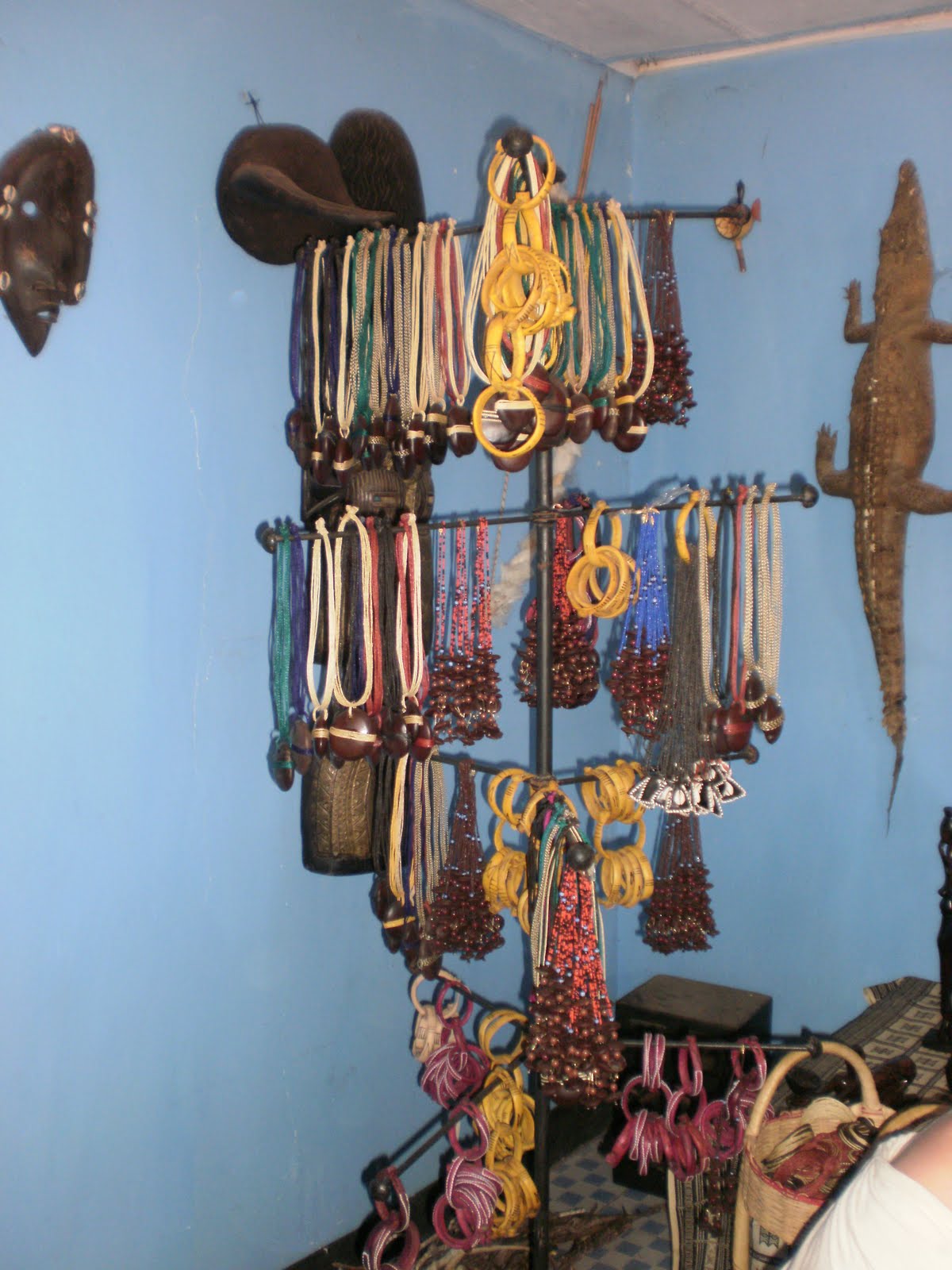
I found some women artisans making necklaces on the Island and I bought several to send back to you to sell (I kept one for myself too!). The rainbow colors mean peace to the Senegalese. I hope that the students love them as much as I do.

After Dakar, I didn’t have any rest before heading straight up to the northernmost region of Togo. Well, that’s not true. I had an extra day to be in Dakar, due to the political violence and civil unrest in Cote d’Ivoire. We were supposed to have a layover in Cote d’Ivoire, but the elections proved to be very contentious and the former president, who has been in office for 10 years (he put off the election for 5 years) is violently trying to retain control of the presidency even though the United Nations supports the other candidate as having gained the majority of votes. In any case, the violence and instability made it impossible for us to keep our original flight plan, so we were rerouted through Mali and arrived in Togo on Monday.

On Tuesday, I headed up to Dapaong, the regional capital of the Savannah region, the driest and poorest region of Togo. It is currently the season of Harmattan, when the wind blows down from the Sahara, carrying along dust clouds that blot out the sun, making it dry and dusty and surprisingly cold, especially at night.

I was in the Savannah region for a couple different reasons. First, we had our quarterly Gender and Development committee meeting and, as a coordinator for the Karren Waid Scholarship Program, I am a member. I had great new for them: I sold all of the bags and aprons that I brought with me to Senegal and the volunteers there want more! The funds we raise from selling these items not only go to the artisans who make them, but also to fund small community projects that have to do with gender. For example, we helped a group of women buy 8 goats, so that they could raise them and breed them so that they could learn how to raise animals, manage money, and save money so they could send their daughters to school whether or not their husband wanted to. In Togo, many girls do not go to school at all, and many others only go to primary school. Once they reach the junior high level, their parents often want them to stay at home to take care of the babies or else help them in the fields or at the market, selling products. It can take a lot of convincing to get a family to continue to send their girls to school. It helps if we can support the mothers to make enough money to pay the school fees.

School fees are not very expensive in dollars – only 7 dollars per year. (3500 FCFA) but this is enough money to feed a family for a week, so it can make a huge dent in the pocket of a family that earns about a dollar a day.

I picked up some gorgeous napkins and tablecloths made by the weaver’s collective in Dapaong and sent some to California. They are all made by hand by a cooperative group, staffed mostly by women, who have been weaving since they were children.

As well as some necklaces and bracelets from a local artisan shop run by a man who goes around to tiny villages and buys the handicrafts made there and brings them into the big city where the handicrafts can find a better audience.

Another reason I was in the Savannah region was to visit the five new volunteers that have just taken up their posts. They had their ‘swearing-in’ ceremony in mid-November, so they had only been in their posts for a few weeks. I was stopping by to see how their community integration, language learning, etc. were going and answer any questions they had.

In visiting the various volunteers, I drank a lot of tchakpa, the local fermented millet drink. It’s like beer, and is a staple drink for everyone who lives in the Savannah region. I liken it to the pilgrims on the Mayflower, who drank beer because they couldn’t trust the water to be free of parasites. The boiling and fermentation process helps to rid the liquid of bacteria, etc.
We drink it out of calabash halves – like a big gourd. They are commonly used as bowls, cups, even spoons (when broken or cut in half).

In one village, I got a real treat! A local ‘Starbucks’.
By which I mean, a guy who puts sweetened condensed milk and dehydrated coffee (Nescafe) into a cup and adds boiling water. It’s delicious. And only 100CFA (less than 25 cents)

The Savannah region is characterized by flat fields (dry and brown in this dry and cold season) punctuated by huge baobab trees.

It is a gorgeous landscape.

The third reason I was in the region was to take advantage of the local historical tourist site: the caves of Nano. These caves were used by the Moba people in their war with the Tchokossi people. They are located about 20 feet from the top of a cliff, making them excellent places from which to survey the land and, using their bows and arrows, take down opponents trying to scale the cliff and reach their mountain-top settlements.
There is a spring that comes straight out of the rock – what a miracle! Women still use this spring to gather drinking water – it is pure and clean from parasites unlike the river water they would otherwise be gathering.

The best thing about the Savannah region is the people. Even though I couldn’t speak any of their local languages (Moba, Tchokossi, Gamgam) I still felt warmly welcomed.

04 October 2010

Rachel's Questions

Rachel’s Questions

1. What is Togo like?

That’s a tough question. Imagine trying to sum up what the United States is like in just a couple sentences. Granted, Togo is only about as big as Delaware, but the huge ethnic diversity – at least 35 distinct local languages! – and the regions with very different climates, the Oceanside Maritime region, lush and mountainous Plateau region, dry Central region that has the largest wild preserve, surprisingly developed Kara region, to the arid and dusty Savannah region. Togo is a developing country, which means that there’s still a lot of work to be done creating the infrastructure that can support and encourage local businesses and non-profits, especially those existing in rural areas, far from the resources of the big cities. The economy is largely based on agriculture, although the biggest export is phosphorous from the mines. Most families have their own small farm where they grow food for themselves; and perhaps enough extra to sell so that they can buy things like powdered milk, sugar or cloth (pagne) with which to make clothes. That’s another cool thing about Togo – a lot of the clothes people wear are tailor-made by local seamstresses.
Because most people work all day in the fields the diet is very starchy. They have to get a lot of energy (calories) from their food without spending a lot of money. The most common food is pâte – basically corn flour mixed with hot water until it forms a thick paste that can be shaped into balls. A sauce based on tomato, hot peppers, and sometimes edible leaves (kind of like spinach) will accompany it. It’s not particularly tasty to my palate, but it is very filling. Togolese people are very generous – especially with their food. If you ever see someone eating, the first thing they will say to you is “hello! Come and eat with me!” Even if they don’t know you, hospitality and welcome are always very warm.

2. When is the best time to join? After high school? College?

The Peace Corps generally requires that applicants have a bachelor’s degree (4-year college degree). The exception is when an applicant has a significant amount of work experience. So your best bet is to graduate from high school and head to a good college, choosing a major that you really like and that possibly has something to do with development work, like pre-med, political science, African studies, social work, communications, French, agriculture, women’s studies, engineering, etc. etc. As you can tell – the specific major you choose doesn’t matter all that much!

3. How long is the application process and what do they look for in someone who wants to volunteer in Africa?

The application process can be really long. Many of us joke that the wait itself helps to weed out applicants who aren’t committed or don’t have the patience to see it through. Patience becomes a very very important virtue once you are in a developing country and trying to work! The application requires a lot of initial information: an essay/motivation statement (why do you want to be in the Peace Corps), your work experience, college transcript, an essay on your experience of diversity or cultural exchange. Plus three recommendations. The ideal for the recommendations is to send in one from an academic supervisor (a college professor who really knows you well), one from a work supervisor (a boss who you did really good work for), and one volunteer work supervisor (someone you volunteered with who can talk about your commitment to service). They really want to see applicants who have already shown commitment to doing volunteer work – particularly in the area in which you want to work in the Peace Corps. For example, if you want to work in community health in Africa, you could get involved as a hospital volunteer or a volunteer at a retirement home. If you want to do youth development, you could volunteer as a youth group leader at your local teen center. If you know you to work in Africa, every single project in Africa has an HIV/AIDS prevention component, so it’s a great idea to already look into the causes and effects of HIV and perhaps volunteer at a relevant center. Also, Peace Corps loves if you already have language ability. For Africa, that could be French, Portuguese, Arabic, or African languages like Swahili.

4. Is it hard to be away from your family for two years? Do you get to visit them while you are still in the program?

Yes, it’s hard to be away from family. I moved away from home when I went to college in 2000 and haven’t lived in California since. So I was used to only seeing my immediate family for short once or twice a year visits. As a PCV, I chose to save up my vacation days (we get 2 vacation days per month) so that I could go to California for June 2009 – it was really important to me to be there to celebrate my brother’s graduation from high school, my sister’s graduation from college, and my sister’s promotion from 8th grade. Some volunteers’ families come over to visit them in country – or they meet at a mid-point in Europe or another “vacation spot” instead of making family come out to tiny African villages without amenities. Peace Corps doesn’t pay for volunteer’s plane tickets to visit home, so you have to save up for that yourself. The exception is for volunteers who extend their service. For example, I did the normal two years of service and then I chose to stay for a third year to take on new responsibilities as a Volunteer Leader. Because I signed up for another full 12 months of service, the Peace Corps requires that I take one month of home leave. They paid for my plane ticket to my ‘home of residence’ – California. It was great to have this break, I feel re-motivated to get back to work!

5. What do you plan to do when you are finished volunteering?

I want to keep working in international human rights, specifically looking at gender and sexuality issues. I’ve been really inspired by my work with young people during my service in the Peace Corps and before (I was a sexual health/mental health youth worker in Scotland before joining the Peace Corps). I am currently looking at going back to graduate school, perhaps for law or public policy, with the goal that I could use the knowledge from these programs to work for the United Nations or the US State Department or a non-profit international organization like Women for Women International or Human Rights Watch.

6. What kind of security do you get? Aren’t you scared of getting AIDS or another disease?

First of all, HIV, the virus that leads to AIDS, is not like a cold – I can’t get it by shaking hands with someone or because someone sneezed near me. HIV is entirely preventable, except perhaps for babies born to HIV-positive mothers, but even then the risk of can be minimized through careful pre-natal care provide by doctors who know the woman’s HIV status. In fact, Washington DC has a higher percentage of people infected with HIV than Togo. That said, HIV prevention, is a huge part of the work I do for a very good reason. Practices that have become normal in American society, like sterilizing a razor between customers at a barbers’, getting pre-natal care for pregnant women, and using a condom, are still out of the norm in Togo. So a lot of the work I do is just repetition, encouraging people to do thing I would consider common sense.
The illness that I worry about more is malaria. Untreated, malaria can be fatal – attacks your liver and kidneys and can leave you unable to process toxins out of your body. Malaria is carried by mosquitos. Peace Corps has a fantastic medical service team that is provided for free to volunteers. Part of the service is anti-malaria pills (called malaria prophylaxis). These pills are so important, in fact, that volunteers who don’t take them get kicked out of the Peace Corps and sent home.
The other illnesses I worry about are pretty common for any travel or work in developing countries: digestive troubles. You will have them; it is inevitable. But in order to help minimize them, Peace Corps Medical does several trainings during the initial three months about proper water preparation, malnutrition and cooking. And when you get sick, they provide your prescriptions, and even a bed at the medical unit if it’s serious enough. Some conditions might require specialists – for example dental surgery or a broken bone – for these Peace Corps will pay for you to get to a facility to receive appropriate care – that could be Senegal, South Africa, or even Washington D.C. They take really really good care of us. In fact, I think it’s the best and most holistic health care I will ever get and it’s free!

7. What kind of things do you do? (Are you a teacher/doctor/etc)

Peace Corps is different in every country but I would guess that most volunteers would agree with me when I say that you don’t walk into a job in the Peace Corps, you create one. Most people think Peace Corps volunteer = English teacher. In Togo, we have four programs that volunteers fit into, and none of them are English teaching. The four programs are: Natural Resources Management/Food Security, Community Health and Family Planning, Girls’ Education and Empowerment, and Small Enterprise Development. The program I’m part of is Small Enterprise Development. Specifically, I’m in a sub-program of NGO Development (NGO = non-governmental organization, or non-profit). I’ve been doing a lot of different activities, the first (and most important) being a participatory needs assessment of the village where I lived. What this means is I talked to a lot of people – I gathered groups of women, student, rice farmers, churchgoers, or teachers and asked them about their village and their work, the cycle of planting crops and the rains. We discussed what’s working and what could/should be improved. Once I had a good idea of what already existed in the village, then I was ready to start projects. I always have several things going on at the same time and over time as I gained experience and knowledge in my village and in Togo in general, my projects became more sophisticated.
· I developed a small group of women leaders to present workshops on business skills and health life skills (communication, nutrition and HIV prevention) to apprentice seamstresses. While I was working with seamstresses I got the chance to practice sewing on a foot-pedal powered machine!
· I started a group of health peer educators at the local junior high/high school. We put together skits about HIV/AIDS prevention, the importance of staying in school, facing up to sexual harassment, etc. and then performed the skits for the whole school.
· I supported a small group working to create a mushroom growing cooperative.
· I taught English to 4 classes of 50-60 junior high students. We learned songs and stories and I focused on cultural exchange – introducing American traditions and holidays – as well as adding to the correspondence exchange with junior high girls.
· I created a business club at the junior high 5 km from my house. We worked on the set of skills you have to develop to know whether a business idea could work. We also worked on some small income-generating activities (like making soap and lotion to sell).
· I organized a camp for Togolese young people from all over the country. I was on a team of Peace Corps volunteers and Togolese professionals. We recruited community leaders to be counselors at the camp, arranged transportation and food for everyone and raised 25000 dollars to run the camp in 2009 and 30000 to run the camp in 2010. I’m particularly proud of helping to coordinate the team of organizers to form a more coherent collaboration among the Togolese non-profits so that they could take on more leadership roles in running the camp.
· I administered a scholarship for girls who are chosen based on both need and merit. The system for approving scholars and sending them their scholarship money needed a lot of reworking. I’m really proud of creating and hosting a national conference for the scholarship girls so that we could better ensure the scholars are getting support both academically and emotionally, ‘cause it can be really tough for girls in school in Togo. About 12 of the scholars this year are going to be in university! Amazing.
· I worked with several other volunteers to create a (huge) document for Peace Corps volunteers who want to work with non-profit organizations or associations in Togo. The resources for this type of work are kind of out-of-date and not specific to working in Africa, much less Togo.
· Seeing the need for better management training for local non-profits, my friend and I put together a workshop for small non-profits. This meant not only teaching the lessons, but also putting together a 100-page document in French! about typical management issues. It was a lot of work but so worthwhile that I am planning to replicate the workshop in another city this year.

8. What is your apartment/room/house like? Do you have access to electricity?

When we first arrived, I lived in a single small room in a house with a family. But once I moved to my village, I was in a house by myself. I lucked out and had a pretty cute house – with a living, bedroom, kitchen and an indoor toilet! The house is made out of cement blocks and has a tin roof. The floor is simply concrete as well. I have lots of windows, which helps with air flow. There’s no glass in the windows – just mosquito screen, iron “burglar” bars, and wooden shutters I can close and lock. The house can get really hot and I didn’t have electricity or running water, so no fans or cooling showers. And even though I had a toilet, I still had to “flush” by pouring in a bucket of water. I get my water from a rain-collecting cistern that’s right next to my house. I kept a large (huge) plastic bucket inside my living room so I only had to go out and fetch water from the cistern once or twice a week. There are a couple shops that have generators so I can charge my phone for a few hundred francs CFA. Most of the time, my electricity access is when I got into a larger city nearby where I can find places to charge my batteries and use the internet.
I have recently moved as part of my new role – I’m in a regional capital now and I have a city house – including electricity and running water! It is amazing how quickly I got used to these new amenities.

9. What about the violence/crime?

Safety and security is a primary concern for the Peace Corps. If they judge that a country is too unstable to be safe; the Peace Corps will pull out volunteers (or not send them). Togo is a relatively safe country and there is a designated Safety and Security Officer who does his best to keep us up-to-date with threats to security. It can be difficult because communications are not as fast as they are in the United States with Twitter, Facebook, even news media, but they develop systems early on in training to ensure that volunteers know where to turn if a safety problem happens. My primary concern about crime in Togo is theft. So I take precautions – like locking my house whenever I leave – even though I trust my neighbors because I feel there is no need to give them the temptation to explore what American goods I might have. There were recently some protests that involved some violence because of elections and gas prices, but no volunteers were caught up in them.

10. When did you know that you wanted to join the Peace Corps?

I’ve thought about the Peace Corps since I was in high school, like you. And I met some amazing returned Peace Corps volunteers who were doing Masters’ in Peace Studies at Notre Dame. So I looked into the possibility several times, but I put it off after college because I received a Rotary International Ambassadorial Scholarship to go abroad to do a Masters’ degree. I went to the University of Edinburgh in Scotland. I loved Scotland and decided to stay for a few years, taking advantage of a work visa program for overseas students who graduate from a Scottish university. Once my two years were nearing the end, though, I started looking at the Peace Corps again. At the same time, I was looking at jobs with international non-profits and almost all of them require a minimum of two years experience working in a developing country. Peace Corps seemed to be a perfect fit: not only would I be pursuing the dream that I’d hoped for since high school, but I’d also be getting career experience that would enable me to work internationally for the rest of my life!

12 June 2010

Transportation in Togo

9 June 2010
It loomed in front of us, the gasoline truck, sprawled across the highway like a great beast, life pouring from its torn belly. The smallest spark would have cause a fire to blow the asphalt off the road. Horror filled me as I watched tiny children soaked in gasoline running home with jugs of the stuff on their heads; rushing back to fill another container. Men, women, taxi drivers, moto drivers, clothes soaked in gasoline, reached out to take their fill of the precious liquid seeping from the downed truck. The cab of the truck had fully separated from the cylinder; the driver looked unharmed but shaky as he paced on the side of the road, speaking into his cell phone. His apprentice driver was seated on the ground, head cradled in his hands, rocking slightly, still devastated by the shock of such an accident.

My stomach writhed and my heart thundered as we slowly passed between the gushing cylinder and the truck cab. One rock kicked off by our wheels, one piece of glass magnifying the equatorial sun, and we would all die… very painfully. My palpable fear was a strange counterpart to the sheer joy in the faces of the women rushing toward the truck with the big bowls usually used for collecting water. Shiny, happy people. Shiny with the slick shimmer of gasoline. The bright smiles on the kids’ faces made me shiver with visions of horror. But to this tiny, lucky village, this accident may prove to be their main source of income for the next six months. One liter of gasoline sells for 500-600FCFA. Each jug I saw carried away contains about 20 liters. One jug is enough money to travel from the ocean in Lome to the northern border with Burkina Faso. Is this the silver lining?

Automobile accidents are common here – we like to joke that when cars die in Europe, they’re sent to Ghana to rot; when they are finished in Ghana, they arrive in Togo. And the roads are bad, especially during and right after rainy season. An aspect that I’d never really picked up on until recently is the state of the tires. At Camp UNITE this year, we started a new “challenge” – a team-building physical/strategy game – that involves three tires per team. So we sent out one of the organizers to buy some used tires. He came back with 6 tires that were completely bare. Every single one was as smooth as a baby’s bottom. Who had these things on their car long enough to end up in such a state?! I’ve started looking at tires more often now. I noticed that on trucks, if a tire is really worn down, they won’t stop using it – just put it somewhere in the middle, so I guess at least it’s not responsible for steering? Yikes.

12 May 2010

Close of service

How did it become the 11th so soon? This month and last have been absolutely ridiculous with busyness. I apologize for falling off the internet yet again.
Last week I had my close of service (COS) conference. Basically, all the kids who arrived with me (that are still in country) get together at a super posh hotel and talk about what the heck we’re doing with our lives now that we’re just a few months away from leaving. It’s a fun three days, but also pretty useful. There was a great panel on job possibilities – three former Peace Corps volunteers and one embassy worker with other international experience. It really made me think harder about taking the foreign service exam. And then the presentation on our non-competitive eligibility for federal government jobs made me want to look up federal openings (basically, as returned Peace Corps volunteers we get a year of ‘inside hire’ status where we can be hired for positions before they are opened up to the public).
So where am I going next?
Well, on the first day of the conference I submitted my formal application to be a third year Volunteer Leader. Yup, that means staying in Togo for another year. So all of you who thought about visiting but never got around to it… here’s your chance. I’m signed up to be here until Aug/Sept 2011.
I’m sure you’re all just dying to read my letter of interest for the position, but unfortunately I got kinda long-winded… four pages. Ridonkulous.
So I’ll skip around, here are some excerpts:


“When I grow up, I want to be a Peace Corps volunteer,” declared the girl with bright eyes, “just like Da Adzo Rose.”
“Thank you, Delali.” I replied. I smiled back at her and continued leading an exercise combining English and goal-setting with the class of 3eme students at CEG Kovié. Delali was one of the students with whom I made a special connection. She’d seen and experienced the benefits of working with Peace Corps volunteers; not just myself but also volunteers from all over the country during Camp UNITE 2009. Her admiration and respect for our work gave her the aspiration to become a Peace Corps volunteer. It is these special connections and relationships that I want to help first and second year volunteers to foster; these moments of inspiration and joy that lead me to apply to become a Volunteer Leader.

My Peace Corps Service
My experience in Edinburgh, motivated me during my Peace Corps service to pursue projects, both in my village and nationally, that focused on empowering young people. In Mission Tové worked with both students and apprentices, using lessons from the Life Skills book as well as teaching good business practices. Last November, after over a year working with my group of peer educators, I encouraged them to develop their own plan for celebrating World AIDS day. I facilitated the discussion, using brainstorm charts and priority mapping, but the ideas and the work were all theirs. They decided to plan a big event for all the students in the two villages of Mission Tové and Kovié. Instead of simply planning and presenting their own sensibilisation, the group chose to invite the two other junior high schools to write and perform their own skits, based on the theme “Youth facing up to HIV/AIDS.” The day was a fantastic success, proven to me by the fact that I didn’t do anything more than move chairs and take pictures; the students took care of everything. They’ve already started planning next year’s event.
I came into Togo as an NGO Development volunteer, a subset of the Small Enterprise Development program, but I hadn’t yet found an NGO to work with in my village so I was thrilled to take on a leadership role in two national projects: Camp UNITE and the Karren Waid Scholarship Program. These two projects will be the focus of my community level volunteer assignment. The non-governmental organization PAHCS located in Amlamé manages both projects. PAHCS has been the NGO contact for Karren Waid since its inception. We have now reached a point where volunteers should be assisting the program rather than running it. I intend to implement a capacity-building administrative process, developing a three-year strategic plan for growth and expansion of the scholarship program. This capacity-building will include lessons on how to maintain databases, setting up the physical workspace, developing filing systems, planning and managing a scholar conference, and holding fundraising events. I will also be the point person for the nascent Karren Waid Foundation currently in the first steps of applying for 501c3 status in the United States. I will coordinate with them on good communication of goals and objectives both on the US and Togolese side.
For the Camp UNITE part of my third year, I will focus on assisting CONGECS, the consortium of three Togolese NGOs running camp, to have their collaboration made official. Much of my role will also be developing a consistent reporting on camp. This will include photos, videos, and testimonials during camp that will serve not only for archive, but also for promoting the camp to our funders, especially the Unite Foundation. A major challenge that Camp UNITE has faced is the lack of follow-up on the young people who have been through the week of formation. I will work in tandem with the consortium to develop a reporting system that helps us to not only keep track of camp alums but also support them with resources, whether that means sending them new information or getting them in contact with a local PCV or other camp alums.

Conclusion
I believe that I would be an excellent Volunteer Leader. I have a strong commitment to the goals of Peace Corps. I am a very talented manager and trainer. I am motivated and creative and willing to put in the time and effort necessary to have real achievements in a complicated environment. I realize that if selected as a Volunteer Leader, I will essentially be creating the position and establishing standards that may be in place for years to come. The process will take a significant amount of time and lots of good and honest communication. I anticipate that there may be frustrations, but I look forward to the challenge.
Thank you for considering my application,
Xoxo ;)


You’d totally give me the job; you know it.
I have not yet had my interview, but I feel confident from informal chats with my program director and the Country Director that my application will be accepted. I’m pretty excited. Especially for the chance to move to a new city and do regional site development.
I hope to move to a city in the region of Plateau. It’s a lovely little city and really close to the village where my NGO collaborator is located (within two hours’ biking distance). I will have electricity and hopefully an internet connection… amazing!
I’m sad that I won’t be bringing little Ody along with me to keep me company. It’s heartbreaking to sit in my house and notice all the little evidence of a cat but not have him sitting in my lap purring or knocking things over. I’ve got to think of some appropriate way to mark his grave or something, a little closure. With all the running around, I haven’t taken the time to grieve. My first pet that was really mine

26 April 2010

La fete des apprentis


La grande foule de filles et garçons vêtu du même pagne dansent et chantent avec une joie de vie qui attirent tout le monde. On voit une longue ligne de filles dansant dans un cercle; on dirait que chaque complet est plus beau que l’un qui l'avançait. C’ est la saison correcte, mais ce n’est pas une funéraille. C’est la fête des apprentis de couture. Une journée de danse, chanson, nourriture, et boisson. Les apprentis se prêtent depuis des mois pour cette grande fête : ils cherchent le modèle le plus joli, le plus unique, et passent beaucoup de temps à faire leur habit spécial. Dans ce grand nombre de gens, on ne peut pas trouver un modèle jumelé. Chacun et une s’habille complètement différemment, mais dans le même pagne. Cette créativité et joie dans leur métier indique une félicité unique aux apprentis.
La fête des apprentis de couture se fait le 10 février de chaque année. Les syndicats de couture se réunissent pour fêter la fin de la saison de fête. Décembre et janvier sont des mois si plein d’occasion que les couturiers et tailleurs n’arrivent pas à fêter eux-mêmes. Mais tout le monde a besoin de s'étendre un peu, boire un peu, et danser avec ses amis. Alors, ils ont prit le 10 février comme un jour ferié spécial à eux.

Cette année, le Syncoutat, un des plusieurs syndicats des couturiers et tailleurs, avait leur congrès national. Trouvant que le congrès et les élection des representants a crée un peu de mal-aise chez les membres, le Syncoutat a décidé de faire une très grande fête avec les bureaux des plusieurs préfectures.

Centaines des apprentis se sont réunis pour célébrer ensemble. Ce partage de joie et expérience est une des raisons pour commencer un bureau de syndicat chez vous. Les syndicats sont une ressource très intéressants aux artisans.

Attirer un bureau de syndicat chez vous ce n’est pas un grand travail, mais il faut de la persistance. En 2006, Da Essi AWUITOR, maitresse couturière s’est décidé qu’elle voulait que ces apprenties passent un examen pour la fin de l’apprentissage pour avoir des certificats. Mais il n’y avait pas de bureau de syndicat chez elle, à Mission Tové. Alors, elle est allée à Tsévié au niveau préfectorale pour parler avec le directeur des affaires sociales. Elle a trouvé que c’était un peu difficile d’attirer un grand syndicat à un petit village. Le Syntacto a donné deux choix à AWUITOR : soit elle amènerait les filles avec leur machines à coudre à Tsévié où un patron local les présenterait à l’examen (la signature de ce patron local figurerait sur les certificats, au lieu de la signature d’AWUITOR), soit elle pourrait faire amener les surveillants à Mission Tové, les loger, les donner à manger, et les payer 5000 chacun par jour pour trois jours.

AWUITOR ne pouvait pas accepter ni l’un ni l’autre de ces deux choix. Elle est allée encore voir le directeur des affaires sociales pour savoir comment elle peut faire. Il y avait un deuxième syndicat des tailleurs à Tsévié : le Syncoutat. Le Président du Syncoutat écoutait le problème d’ AWUITOR et s’est décidé de l’aider. Il viendrait lui-même surveiller l’examen à Mission Tové, s’il pouvait être logé; avec une condition: après l’examen soit AWUITOR doit se joindre au Syncoutat à Tsévié, soit elle doit créer un bureau du Syncoutat local. Notant les frais de déplacement, AWUITOR a choisi d’installer un bureau local. Elle se promenait un peu partout dans le village pour parler avec les autres couturières et tailleurs qui s’intéressaient un peu à ce qu’elle disait, mais ne voulait pas mettre aucun force derrière leurs intérêts.

Pour l’examen pour le certificat, un apprenti passe une journée en faisant un complet d’une modèle indiquée par les surveillants. Sa facon de travailler est observé pendant la journée et à la fin, le surveillant fait la correction du complet pour assurer la qualité du travail. Arrivé le jour de l’examen à Mission Tove seulement un tailleur était venu pour regarder ce qui se passait. Mais le Président du Syncoutat de Tsévié, étant très intelligent, a fait entré trois patrons pour lui aider à faire la correction des travaux que les apprentis ont fait. Il a dit qu’il ne pouvait pas amener les habits jusqu'à Tsévié pour la correction, il devait le faire le meme jour. Mais il ne ferait pas la correction seul parce qu’il ne voulait pas que les autres patrons croient qu’il a fait préférence pour AWUITOR. Les trois patrons les plus connus et respectés étaient appelés pour l’aider. Le fait de voir et participer dans le procesus de l’examen a encouragé beaucoup l’intéret des patrons envers l’installation d’un bureau chez eux. C'etait un succès des deux cotés.

Le jour de la fête de la libération de ses trois apprenties était le même jour de l’installation du bureau.

Les patrons ont constaté plusieurs bénéfices d'être membre d’un syndicat. D’abord il y a la fraternité; ils sont ensembles pour se soutenir et pour s'aider avec les problèmes communs. Deuxième il y a un système de discipline et d’inscription pour les apprentis. Avec les contrats signés, les patrons ont plus de puissance légale sur les apprentis qui volent ou qui veulent échapper de leurs obligations. Troisième, les apprentis gagnent un certificat connu partout au Togo pour bien montrer qu’ils ont fait la formation en couture et qu’ils ont réussi. La possibilité de ce certificat attire beaucoup d'apprentis vers un maitre qui fait parti d'un syndicat.

Si vous voulez installer un bureau du syndicat chez vous, allez aux affaires socials et les demander une liste des syndicats dans votre métier qui sont installé dans la préfecture. Meme si vous n’avez pas de certificat vous-meme, vous pouvez vous joindre à un syndicat pour le bénéfice de vos apprentis.

12 February 2010

School

10 February 2010

In class today I was working on helping the students to write an essay in English for the test at the end of college (junior high). Last year we had about 30 students take the BEPC, only 9 of them passed. It’s not just because of English, it’s a multi-subject test over several days; last year the school didn’t have a science or a math teacher. I’m hoping that this year will have much more success – the professors we have now are all fantastic and motivated and we’ve acquired 3 new professors so we have the full complement (except for English, which is why I’m still around).

I checked out a bunch of old English BEPC tests and put together a guide for success writing the essay. I handed out the guides to my 3eme class (the class that will be
testing at the end of the year). We’re working our way through each type of question. Today we worked on the prompt:

Describe a member of your family you like very much.

(Yes, the prompt is slightly awkward – I took it directly from a past exam. It’s shocking how many faults there are on this nationally administered exam)
We broke down the different important elements: writing sentences describing the person’s age, appearance, family relationship, likes and dislikes, etc. Finally, what I found most interesting, were students’ sentences about why they liked this family member so much.

A selection:

I like my mother because she gave me life and takes care of me.
I like my mother because she gives me money to go to school everyday.
I like my father because he pays my school fees.
I like my father because he gives me money to buy beans at school.

They made me think about how so many kids don’t go to school here. Their labor is too necessary to spare them to go to classes, plus playing the school fees. So parents being generous enough to send their children to school is truly something special.

My pastor friend Koffi receives a salary from the church of 15000 CFA per month – that’s less than a dollar a day for those of you who are counting. Most people do not have salaries; they live according to the sales from their fields. Being able to put aside enough money to pay school fees and send your kids to school with enough money to buy breakfast is almost a luxury here. I read a study once that indicated that in rural areas in the developing world illiterate parents are more likely to send their children to school than semi-literate parents. There’s a sense that they were missing out on something really good and want to make sure their kids get a chance to have an education.

I think I just want to say thank you to all those parents, in Togo, in Africa, in America who place value on their kids’ education no matter what their circumstance. It’s an amazing gift.

24 June 2009

Rose is AWOL


A brand new adventure for me!

I lost my passport somewhere between New York and California, but didn't discover it until 10pm Sunday night.

I was supposed to fly back to Togo Monday morning at 6am.

Oops.
So I spent about seven hours ransacking the house to search for the passport, finally gave up and contacted the airline, peace corps in DC, peace corps in Togo, and everyone else necessary.

I'm in the 'leave without allowance' limbo now until I can secure a new passport. My FedExed application (along with NINE new passport pictures) should have arrived in Washington, DC this morning. I'm anticipating being in California for at the very least another 10 days.

I still kick myself occasionally, but it's like a 'free' vacation. It's a good thing I get along with my family :)


In other news, I'm going to use this week to research law schools and LSAT study preparation. ... yikes

18 May 2009

Fast food in Togo


Hello! I hope you are doing well.

I'm in Lome today working on getting all the information to start up the administration of the Karren Waid girls' scholarships. It's all really exciting. Tomorrow I head to the new training site for the group of volunteers who will be arriving on the 6th of June.

Things have gotten pretty hectic at school with students preparing for exams, but I was finally able to get the students to read over your classes' questions. It's always amusing to hear their reactions and try to explain the cultural differences.
In response to:

Period 1—Hello from first period history class! We liked hearing about your day and the sports you play. We all play sports too. We like soccer (what you call football), basketball, riding horses, softball, volleyball, cheerleading, and tennis. We do not know what “star tennis” is—could you explain that to us? Also, we were wondering if there is fast food in any of Togo’s larger cities, like the capital. Thank you for your letters!


From the 4eme class:

Star tennis is the same as table tennis or ping pong.


Fast food


I explained fast food to them as restaurants that you can find all over the US where you can go in and quickly get food and then leave.

The students then listed what kinds of ‘fast food’ they can get.

rice, beans, salad, bread, pineapple, pate, banku (the pate of cassava), fufu, soja, millet porrige.

We find these in the market. We sit on benches and eat quickly. Sometimes we stand up to eat. We eat out of a bowl with out fingers or sometimes a spoon.


Many of the students have not been to any of the big cities yet so they wouldn’t know what is available there. So I will also answer your question myself – there aren’t any of the fast food franchise restaurants like Burger King, KFC or McDonalds here. The ‘fast food’ here is street food – women selling prepared food cheaply and quickly. At any restaurant here, even if all you want is salad, you will almost always have to wait for about 30 minutes minimum to receive your food.

But... I have seen a food place called ‘Al Donald’s’ that is painted in the same red and yellow as McDonalds – and even has a single golden arch as part of its logo!

I have yet to eat there, but I plan on getting a picture :)

Period 2—Hi, we are Ms. F’s second period class. Thank you for sharing with us how your day is structured and what you have for snacks. We liked hearing about the sports you play. We play soccer, track, horse riding, swimming, tennis, and water polo. We also like to dance! We were wondering what subjects you study at school. We study religion, math, English, literature, history and p.e. (physical education). Also, do you have any pets? We mainly have cats, dogs, fish, and birds. Some girls have horses and more exotic animals. Thank you again for writing to us!

From the 6eme class (youngest in the middle school - roughly equivalent to 6th grade)
Subjects we study: English, Math, History and Geography, Civic and Moral Education, French, Life and Earth Sciences, Physical Labor/Field Work, Agriculture, Sports.

Some of the animals we have at our houses: frog, cats, snails, dogs, mouse, ducks, bat, turkey, rabbit, goat, sheep, rat, pig lizard, horse, monkey, chicken, cockerils, crabs, parrots, crocodiles, elephants, and lions
(the last four were a joke - one of the students said his father is an elephant and everyone else chipped in from there comparing their family members to animals. It was very silly and fun)


I'll work on getting a response to the rest of the questions next week!

Cheers,
Rose

I've attached two photos of 'fast food' in Mission Tove

The first is of me with the ladies who come to the school to sell food at the break
The second is of a group of apprentices eating during their morning break at the local rice and beans stand.

Published story!

I was selected as a finalist in the National Geographic/Peace Corps short story contest about the food crisis.

Check out my story!