Showing posts with label village life. Show all posts

26 January 2010

Visite du chef

26 January 2010
I've just arrived at the chief's house for our expedition to Afedome - a small village that is part of the Mission Tové canton. We were supposed to leave at 7 am. This is impossible as it is 7 am and there is no car here. The chief isn't even dressed. As I arrived into the little private paillote in the inner courtyard of his house, I glimpsed him through the window - naked to the waist (possibly further, but thankfully that's all I could see). He saw me as well and grinned sheepishly.
We left at about 730, not bad considering they had to reinflate two of the four tires. A fact that made the chief both giggle and fume - he just bought the tires in Ghana last week!

We took a really tiny winding path out to this tiny village. The path would have been tiny and winding on my bike - in the car we just crushed everything for several feet on either side. I lost track of the turning early one, but I'll try to be more observant on the return trip.
We are not sitting at an itsy-bitsy primary school. There are only twelve students. It's just two paillotes. It looks like they have more bancs than pupils!


This meeting is being conducted entirely in Ewe. Occasionally Togbui (the Chief) explains a bit to me in French. He's very disappointed at the number of people who have shown up.
Apparently each quartier has created a village. The Chief wanted to bring me ot the village from his quartier - a bit of admitted nepotism.
The kids seem kinda shell-shocked. They aren't tittering or getting excited about seeing a yovo in the way I've gotten used to. I took a couple photos and then shook each of their hands to try to entice them into reacting. It was fun. Now they're smiling a little.
The breeze is cool, the sky a familiar Edinburgh gray, which is slightly confusing in contrast to the red earth and bright green farmland. The gray skiy of Edinburgh seemed a natural extension of its stone buildings and black tarred streets. The brightest spots of colour were the Lothian buses in fire-engine red. I wonder if the gray skies here will burn off into a hot day or actually deliver their promise of cooling, life-giving rain. Probably the former, but I'm still hoping.

24 January 2010

Le premier pas

24 January 2010
One of the men that I've been helping over the past year is currently preparing to be married. Koffi is a Baptist pastor. His father died when he was a toddler and his family didn't value education so he left school before getting to high school. Somehow, though, he continued studying and learning and speaks very good French and reads and writes English pretty well. I have been helping him to correspond with a couple in the states that have chosen to support him with his work with his church, especially with the poor and orphaned children. It's an interesting position to be in; I don't really feel it is my purpose or desire to fundraise for local churches, but I really like Koffi and I know he uses the money well.
Most recently, they received some money and Koffi decided to forego the holiday party (complete with a rented sound system and generator) to instead pay the remaining school fees of the children in his church, many of whom had just been suspended for not paying their annual fee of 3,500 CFA (about 8 dollars).
Anyway, he's a good guy with priorities I agree with, so it's particularly exciting for me that I'll be here for his wedding! The marriage isn't arrange, but there are still lots of family customs to observe. Koffi and Akou have already agreed they would like to marry. Now Koffi needs to send a couple highly-respected family members to the house of Akou's family to introduce him and the idea of marriage. If the family is welcoming to these guests, Koffi himself will go to visit, bringing along three bottles: one soft drink, one bottle of gin, and one bottle of sodabe (local gin distilled from palm wine). The parents will see Koffi, then leave him waiting alone outside the house while they seek out the daughter, Akou, to ask her if they should accept the bottles (and thereby accept the proposal). At this point, we hope everything will go according to plan - Koffi and Akou have already spoken to each other and should want the same thing. IF successful, Koffi will then wait around for another while, waiting for the parents to put together the list for the "dote" or dowry.
The contents of a dowry are very different depending on the family. It is interesting, though, that it's the groom that provides the dowry, no? Most dowries will include more bottles of alcohol, several outfits for the wife - pieces of cloth with matching headscarves, shoes and jewelry-, and a sum of money. It'll be interesting to see what Koffi will have to provide!
The groom has to gather the dowry and return to hand it over before further wedding plans can go ahead.
I'm going with him to visit the family, lending foreigner prestige and my digital camera to record the event! I'm looking forward to an adventure.

08 January 2009

Rest in Peace


RIP Arabella Togo Strange

My pretty little chicken was stolen just before New Years Eve.

I hope that whoever took her had lots of hungry children and they enjoyed a yummy Bonne Annee feast. And that this year they will have a really successful business so they can buy their own chickens for next year’s feast and not steal those of other people.

And then I cried (only a little).

Kittens!!!!!


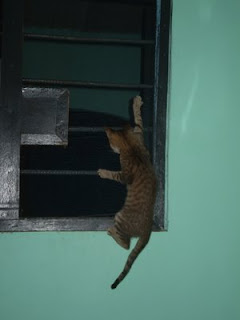
Assorted pics of my borrowed kitten... now returned to L and I in Tsevie


Spiderman got his superpowers by being bitten by a spider. Spidercat got hers from biting the spider.

Kitten on a bike

Kitten practicing spidey skillz.

Kitten lounging – good thing I wasn’t too set on reading that.

04 December 2008

C Match 4 December 2008

Dear LR;

In looking over the last email and questions, I realized that I didn't answer the question about chores very completely.

Sometimes I forgot how very different simple chores are here. Every morning I wake to the sound of roosters crowing and my host family sweeping the compound (the land around the 3 small houses that are all part of the household). They sweep away the leaves that have fallen during the night, the various bits of trash, and chicken droppings. I joined them a couple times for sweeping, but 5.30am is very early and I've become used to having a little bit extra sleep.
During repos (the extended lunch hour that usually goes from about 12 – 2.30), though, I go around collecting the piles of leaves to add them to my compost pile. One of my most frustrating things here is the lack of trash collection – people throw candy wrappers, plastic bags and packaging wherever they've finished using it. It gets swept up in the morning and left on the side of the road as if people expect them to decompose along with the leaves! I have to sort through the piles of leaves before adding them to the compost. I'm working on a craft project that will use these pieces of litter. Hopefully this will not only provide a source of income by selling the crafts, but also provide an incentive for not littering.
In order to get rid of my own trash, I have to burn it. I do my best to set aside the things that I can recycle and of course I set aside the kitchen waste for my compost, but the rest has to be burnt so that it won't take over the house or spread germs.

Laundry is washed by hand and dried on clotheslines in the sun. I realized quickly that I'm not very good at hand-washing so I hired a local girl to wash my clothes. She is 13, named S, and is an orphan. She moved in with her aunt here in Mission Tove last year because the village she was from doesn't have a junior high and she really wanted to continue at school. The money I give to her is going toward her school fees and a new outfit for her baptism in the spring. Every Friday I bring my dirty clothes to her to wash and dry at her house. She brings them back by Monday. (I wash my own undergarments, though, because it's considered very rude to have someone else wash them for you. I have a clothesline hanging above my shower area to let my things dry in a private place. My main clothesline is in front of my house, so anything I hang out there will be seen by everyone passing by.)
Washing dishes is also by hand. Because I don't have running water, I use a 3-bucket method: one bucket with water and soap, a second bucket with rinse water and a third bucket with holes for drainage for drying. I get the water for washing from my cistern. I've attached a photo that shows my set-up for getting water:my cistern, which luckily is just next to my little house
the black bucket for carrying water inside (it's also my shower bucket)
the little metal bucket for fetching water out of the cistern (the rope is almost not long enough, the water level is so low already!)

the cloth frame I put together to help filter out the bugs and leaves before bringing the water in the house where I will boil it and filter it before drinking it.
I put my waste water from washing clothes and dishes into a bucket that I keep next to my toilet for flushing. No running water means no handy flush lever. I have to pour water down to empty the bowl.
You can do this in California – it saves a lot of water in drought season! Just set a bucket under your showerhead to catch the cold water while you wait for it to warm up. Then use the bucket to flush your toilet or water your plants (If you use it to water plants, try not to get any soap in it!)
One of my favorite authors wrote: “Abundance in a system comes not just from how much energy or resources flow in, but how many times that energy and those resources recirculate before flowing out.” In Mission Tove, where water is scarce, I am doing my best to make that water recirculate so I can create abundance rather than being a drain on resources.
Cleaning the house is also a fairly new experience. Lizards, spiders, and ants don’t seem to recognize any difference between indoors and outdoors. This means that I am constantly battling insects, webs, and droppings. My floor is just cement, so I simply sweep every room every day (or as often as I have the energy and time for it). Brooms here don’t have handles, so they can be a bit tough on the back. Sometimes I hire a couple local kids to come help me clean. It’s a big, sweaty job to do it alone. It’s nice to have the company and I always give them kool-aid, candy and some money for their help.
Well, that’s a pretty good summary of my chores. For the question about what I eat: here are a couple recipes for Togolese food that you can make from ingredients you can find in California.

Peace,
Rose

“Dirty Rice”

Ingredients:
2 cups rice, washed (I use locally grown rice, and I have to be really careful to pick out any small stones when I wash it. It’s no fun biting down on one!)
3 cups water
1 medium tomato, chopped
1 medium onion, diced
2-3 large cloves of garlic, crushed and minced
1 or more hot peppers, cleaned and minced (we use dried red peppers here)
2 Tbsp vegetable oil
1 Tbsp ground cumin
Salt and black pepper to taste

Directions:
Wash the rice well, add water, salt, tomato, onion, garlic, minced pepper, and oil. Bring to a boil uncovered over high heat. Stir once. Reduce heat and simmer, covered with a tight lid for 15 minutes or until rice is done. Remove from heat. Fluff with fork. Cover and allow to steam an additional 5 minutes. Add plenty of cumin and black pepper.


Pâte Rouge

Ingredients:
1 small onion, chopped
1 cube of bouillon
1 small can tomato paste (70 grams)
1 ¼ Cups corn flour
1 green pepper, chopped
½ tsp piment powder
1 ½ Cups water

Directions:
In a saucepan, sauté onions, green pepper in a little oil until tender. Stir in piment, bouillon and tomato paste. Cook together before adding water. Bring to a boil. Stir in corn flour and mix vigorously to get rid of lumps. Scoop balls of pâte into small plastic bowls or small tupperware containers and allow it to cool for a bit. Invert onto a plate to serve. (perhaps with the pepper sauce below...?)


Pepper Sauce

Ingredients:
6 large tomatoes, chopped
Salt to taste
Hot dried peppers to taste (or piment powder)
1 large onion, chopped
Water

Directions:
Boil tomatoes and onions in a little water until soft, adding salt and piment to taste. If you have a grinding bowl (mortar and pestle): transfer the mixture to the grinding bowl and grind until the consistency is smooth.

28 November 2008

Correspondence Match 28 November 2008

Hi LR,

I am currently in Lome, I have come into the capital city so that I can celebrate Thanksgiving with other volunteers. Every year, the country director hosts a big party with traditional holiday treats including two turkeys imported from the states and cranberry sauce.
It's an amazing feast especially for the volunteers who haven't been home since arriving in country.

In response to the students questions:

My Typical Day

On a typical school day (Monday through Friday) I wake up at about 6am (dawn). Most of my neighbors wake up an hour before me and begin sweeping the paths around the houses, starting the fire for cooking breakfast, etc. The roosters start crowing about 5am and continually compete for who can be loudest and longest, and therefore prove their ability to be good fathers for chicks. It's amazing, but after 5 months in country I've become able to sleep through rooster calls.

I wake up and open up the shutters around my house so I can have enough light to see by. I usually warm up some water from my filter to make coffee (instant nescafe) or tea with sugar and powdered milk. I also put on a big pot of cistern water to boil. I let the big pot come to a rolling boil and stay there for one minute before turning the heat off.
The water then sits in the covered pot until it cools enough to pour into my filter. It usually takes about 8 hours for the water to cool enough to pour into the filter. I boil and filter all my water because if I do not it tends to taste like my tin roof. This is understandable since all the water is collected from the runoff from my roof.

How I cook:
My stove is a gas stove. I don't have an oven or anything like that; the gas bottle connects directly to the stove and when the gas runs out I have to lug the bottle to the capital city and search for several hours to get it refilled. There's currently a gas shortage in the country so it's often hard to find gas. When I first arrived at my post, I didn't have a gas bottle yet so I had to cook on a charcoal stove. It's kind of like using a grill, except that charcoal does not come in nice easy long-burning briquettes here. I had to fan the coals to get them hot enough to cook my dinner. It was very frustrating and took hours to cook and boil my water, I am very glad to have my gas stove now.

With my morning coffee or tea I tend to eat a piece of fruit - I have an orange tree outside my house - or some bread. I can only buy bread on market days, though (Wednesday and Saturday) and bread here doesn't have preservatives so it doesn't last much more than a day, so I don't have bread very often.

If I am quick enough, I have time to take a bucket shower. Then I hop on my bike to go to the complexe scolaire (college/lycee) where I will chat to the other professors about my programs, work on my french exercises and generally gather ideas and promote my own ideas. I use the other professors at the school to help develop my ideas for the area and work on my French.

There is a break at 9.45 for the whole school, I usually buy 100CFA (approximately 25 cents) of rice and beans and spicy sauce to eat. For the break, several women come to the school to sell snacks to the teachers and students. In addition to rice and beans, there are little fried cakes that usually have a bit of fish or tomato sauce in the center. I can also find a warm drink called "bouille". It's made out of the local starchy staple food, manioc, and is mixed with milk and sugar to make it tasty. All the professors meet together at a table either underneath the mango tree or in the new library building. Often the proviseur (principal) will use the time to have a quick meeting with all the teachers about school things.

I usually leave the school after the break and head to my homologue's house. "Homologue" is the term for the host country national that serves as my guide/liaison with my community. My homologue's name is Da E. She is a couturiere (dressmaker). She has a small dressmaking workshop at her home where she teaches three girls the trade. Normally apprentices have to pay for the training but my homologue offers the training for free to girls who come from poor families who don't have the money for the fees. I generally spend two hours at her house. We talk about my projects and the apprentices teach me how to use a foot-pedal sewing machine and how to replicate African fashions.

At noon, I bike home (it's about a 10minute bike ride). I do a little sweeping, gather water from the cistern, and gather leaves and kitchen waste to toss into my compost heap. Once the chores are done, I do about an hour of yoga. Yoga is really important to me - it helps keep my body in shape and is great for clearing my mind of the busy-ness of running about the village. I'm not always hungry at lunch, I find that the intense heat of midday wipes away my appetite, but I make sure to drink a lot of water and I'll often have some fresh papaya or banana if I can find them.

After yoga I usually take a quick bucket bath before heading out for afternoon activities. Some days I have a club in the afternoon at the high school, other days I go back to Da E's workshop. If I don't have anything in particular planned, I will stay at home to work on French exercises, clean the house, develop lesson plans for the various groups I'm working with, or just read for fun.

What I eat:
Sometimes I will go out and chat with my host family in the afternoon.
Often they will invite me to eat with them. They tend to eat one of two staple food: pate or fufu. Pate is made from cornflour, fufu from manioc or igname (two root vegetables that are grown and eaten all over West Africa). With the pate or fufu, they have sauces. There's a peanut-based sauce, a slimy sauce made out of 'gboma' which is a leafy vegetable kind of like spinach, and tomato-based sauces.

If I'm making dinner for myself, it's usually based around vegetables: tomato, onion, and a tiny little yellow version of eggplant. I'll either make a vegetable soup, a stir fry, an omelet, couscous or pasta.
On market days I can find fried tofu pieces called soja that are really yummy and go beautifully in a stir fry. I was a vegetarian for 5 years, but since arriving in Togo, I have started eating meat again because I worry about getting enough protein. Vegetarianism is also not very well understood here. When people invite you over to eat at their house, they will specifically make a meaty dish to honor their guest and often set aside the largest bits of meat for their guest. It is nearly impossible to refuse the meat without being rude. In general, though, I prefer not to eat meat. I get my protein by eating beans and lentils, eggs and milk and soja. I recently bought a chicken so that I can have a ready supply of eggs. (I've named her Arabella after a character in a book I just finished reading called Jonathan Strange and Mr. Norrell).

I make dinner around 5.30 and usually settle in for the night with my books afterward. On Tuesday and Saturday nights, though, I have choir practice at 7. But I don't have to go far for that - the choir practices on the steps of the church that's only about 20 yards from my house.

I tend to go to bed around 10pm, tucking my mosquito net in carefully around me so that I won't get bitten while I'm asleep.

Happy Thanksgiving!

18 November 2008

Correspondence Match 18 Nov 2008

I have started a correspondence match with a 7th grade history class at my high school alma mater (wow, I graduated 8 1/2 years ago ... that's aaaages) I've decided to share my responses here on the blog (with some editing for anonymity of persons other than myself). Enjoy!


Dear students,

Thousand Oaks is very different from Mission Tove; electricity and running water are just a few of those differences! Because Togo is almost directly on the equator, we don't have much of a change in the times of sunrise and sunset like I was used to in Thousand Oaks. I can pretty much count on the sun rising and setting at 6am and 6pm respectively. This means that I have to make sure to do all my household chores between these hours as it's really frustrating to try to clean my room or cook dinner with only candles to light my way.
(I've attached a photo of me cooking by kerosene lamp).

One of the rooms in my house has a window that gets good afternoon sunshine, even right up until 6pm. I usually choose to settle in this room for reading and studying after I've returned from meetings or groups during the day. When I find myself starting to squint to read, I put the book down and set up a few candles on my various tables.
Usually I will cook dinner in the last half hour of sunlight - it's too dark to read by, but I can cut vegetables and stir pots without too much difficulty. Once the sun has fully sunk beneath the horizon, I go outside with my hand-crank flashlight (a flashlight that doesn't require batteries - just a frequent cranking motion) and close the wooden shutters for most of my windows. I have to leave a couple open to get enough air flowing to sleep peacefully. Even at 9pm, when I usually go to bed, I am often wearing a light nightgown and still sweating in the constant warmth.

Between sunset and bedtime, I usually light four candles and work on various craft projects while listening to news programs on my short-wave radio (BBC News World Service has become my best English-speaking friend). Most people here do not have candle holders, they will simply dribble a little bit of wax onto the surface where they are placing the candle to help make it stick. I've learned to improvise candle holders so that they are more portable. I have an old ketchup bottle, several tuna fish cans, and a big can filled with sand as my candle holders. I'm still experimenting with making hanging candle lamps - in my first attempt, the candle melted the string that was holding up the can! Luckily I caught it before it fell, but I'm being much more careful now.

One of the interesting things about living without electricity in Togo is that it can be much less frustrating than living with electricity.
This is because the electricity lines are pretty unreliable, so one can get really used to having electricity and suddenly when the lines are cut, your world tumbles into darkness and your mood goes with it.

As far as running water goes... I really do miss that. I collect my rain from a cistern that's just outside my house. The water in the cistern comes from the rains (I have a drainpipe runoff that goes directly into the cistern). This means, though, that in the dry season - from November to April - it will almost never rain and the cistern will quickly empty. Once the cistern is empty I will have to hire young men and women from the village to walk the mile to the river to collect water for me. The huge jugs will be carefully filled and then lifted to be carried back to my house on their heads!

Not having easy access to running water has made me really careful about my water use. I use the runoff from my bucket baths (fill a bucket with water and use a large cup to pour the water over yourself to get clean) to flush my toilet and water my plants.

Well, that was a long answer, I hope you found it interesting.

Thanks for your question!