01 April 2009

This is not an April Fool’s


I ate a handful of termites yesterday. Salted and grilled. Mmm crunchy.
Actually not as crunchy as I’d expected. I sat for a good ten minutes contemplating the bugs in my hand, trying to work up the nerve to pop them in my mouth like all the other teachers were doing – with relish and gourmet suggestions for improving the spice mixture.

As the end of the second trimester of classes, yesterday was a journée culturelle: the students perpared dances, songs, and skits. And one of the professors decided to make it ‘educational’ and get a group of students to do an exposé about why education is important and what’s going wrong – why girls drop out to have babies, etc.
The Inspector for the region came by for the party. It’s been interesting to see the teachers’ reactions to him. Most teachers have not been paid since the beginning of the school year. There was a small strike about a month ago and all of my professor friends are complaining about not having enough money for food. It’s really distressing. The Inspector has come by to inspect (duh) the school and ensure that it is a quality institution. Hopefully passing an inspection might speed up the process of actually getting pay checks?

In any case, the teachers ate very well today. In between the dances and skits and the final soccer match in the afternoon, there was a ‘pique-nique’ scheduled. So all the classes brought along various foods. Every time a student walked into the school with a basket on her arm (it was the girls who did all the cooking obviously), the teachers called her over and demanded a toll – they had to give one full bowl of food to the teachers. We ate tons. Judging by the towers of food left after the pique-nique, none of the students went hungry either. In fact, I kind of pity the soccer players trying to play a match after stuffing their bellies. Ouch!

In addition to the soccer game, a bunch of other games were set up around the grounds – table tennis, basketball (on a sandy court?!), and an interesting traditional game which involves rolling nuts across the ground to knock out the nuts of the other team. Surprisingly mesmerizing.


P3221547.JPG
P3221552.JPG
P3221597.JPG

26 March 2009

Spider and Death Folktale

Spider and Death
Yiyi kple Ku

At one time, there was a very great famine, to the point that even lions could no longer find any game. Profiting from these circumstances, Death went to the jungle and cleared an immense path – as long as from here to Sokodé* and along it he lay out lots of traps. All the animals that took this path, looking for a place to find food, were captured by Death. He therefore gathered a huge amount of meat. One day Spider visited Death and said to him, enviously:
“Oh! You have lots of meat here at your house! Could I please take a little home with me?”
“You make take a basketful,” responded Death generously.
Spider, being very clever, then made a huge basket that extended all the way from Ho to Akoviéfé, and piled it high with meat to bring back home. In thanks Spider gave his daughter Yiyisa to be Death’s bride. From this day on, Spider could come and take as much as he wanted of Death’s meat.
When Yiyisa arrived to share Death’s home, Death gave her the following instruction:
“Do not ever take the path that I cleared in the jungle, instead you must take the one that is overgrown in order to get yourself to the river.”
One day when it had rained Yiyisa was taking the overgrown path in the jungle and found that the grasses were very wet, making her dress soaked and heavy and her feet muddy. When she looked to her right, the cleared path looked so dry and easy that she decided to move over to it. Before she could take her second step upon the cleared path she fell into a trap and died instantly.
When Death came by collecting the prey from his traps and found his new wife, Yiyisa, dead at the bottom of a trap, he cut her up into little pieces and smoked the meat.
One day, Spider came to visit Death. Death gave him a hearty welcome feast. When Spider had finished eating, he readied himself to leave but first he asked for news of his daughter.
Death replied to him “When you sort through the pieces of meat, you will find her.”
Very intrigued by these words, Spider said: “How could one find oneself in pieces roasted above a fire without being dead?”
At these words, Death spoke again “I warned both of you very well.”
Spider looked through the pieces of meat and found the remains of his daughter. He then said to Death:
“I am going back to my house now but I will return soon to make war upon you.”
At home, Spider sharpened his machete and sharpened it again. Then he threw a stone into the air. When it fell down back to earth, two perfect halves of the stone rolled away, the knife having spliced the stone like a soft cooked yam. But Spider said, “The knife is not yet sharp enough.”
He sharpened it once again. He sharpened it so well that all the flies that landed on it were instantly transformed into water droplets. Then Spider left to confront Death.
When Death saw him coming, he shot an arrow at him, but Spider dodged the projectile, and it was lost in the jungle. Immediately, the whole forest became a huge inferno. Death, astonished that he’d missed Spider, struck up his hunting song:
When the arrow hits the elephant
The elephant dies
When the arrow hits the hippopotamus
The hippo dies
When the arrow finds the target
The target dies

Spider also burst into song:
Funo, funo my wife
Is there a place on earth where one can never go?
To return or to fall there, I go
The fire and the sword come
Funo funo

Spider then threw his knife, cutting all the trees and vines around him. But despite his brave song, Spider was afraid of Death’s power and the growing inferno and he escaped by retreating to his house, the knife continuing to cut by itself all that was in his path. Having arrived at home, Spider hid himself in his hut. Death followed but lay in wait for him at the edge of the village, intending to kill him as soon as he showed himself. That morning, at dawn, women left the village to fetch water from the river and, making their way, they chatted and laughed joyfully. Death shot an arrow at them instantly, killing many of them and wounding others. The survivors ran back to the village screaming,
“This woman is killed, this is dead.”
Death came closer to contemplate the bodies and said
“There is enough prey here, why do I go all the way into the jungle to hunt?”
This is how Death came into the world of men. If Spider had not done what he did, Death would never have been brought into our world.


*Sokodé is in the Centrale Région of Togo, which, unsurprisingly, is just about halfway up the vertical length of the country. In miles, it’s approximately 300km from Lomé to Sokodé. I chose Lomé as the point of reference as this tale is from the Éwé people, who live primarily along the coastline in Ghana, Togo and Benin. In today’s circumstances, Sokodé is about a 4-hour drive under good road conditions. Not a huge distance to Americans – (on American roads and in well-maintained cars, the distance would take much less than 6 hours). But it is a sufficiently long distance for the ethnic group and local language as well as religious beliefs to be markedly different. These differences lead me to believe that saying the path stretched from here to Sokodé is along the same lines as the familiar American phrase “From sea to shining sea”. It indicates a path that stretched all the way across the “known world” or at least the Ewe-controlled lands.

Give a little?

My dear family and friends,

As you all know, I've been living in a small country in West Africa called Togo for the past nine months. I live and work in a village called Mission Tové, where I work primarily with young people in all sorts of ways: teaching English, teaching business skills like how to do a feasibility study, helping to develop a plan for an apprenticeship center for young people who don't have enough money to pay for the training.

Over the past few months I've been balancing my work in village with a national project - a summer camp for young people from all over Togo. The camp is called Camp Unité and was originally started in 2001 to help address the tension among the various ethnic groups - hence the name Unité (Unity). Over the years it's expanded and now it is four weeks of camps - one week for girl students, one week for boy students, one week for girl apprentices and one week for boy apprentices (apprentices are young people who have gone into learning a trade like carpentry or dressmaking).

Each week, 16 counselors - 8 Peace Corps volunteers and 8 Togolese facilitators (nurses, teachers, apprentice trainers, and other resourceful community members) deliver a program to the the young people teaching them life skills like communication strategies, conflict resolution, time management, and self-confidence. We also facilitate sessions on important but often under-discussed subjects like child trafficking and teen pregnancy.

The camp has been enormously successful, with participants going on to form youth groups in their villages to help further distribute the ideas and skills that they learned. Last year, as part of Peace Corps' goal to make projects locally run and sustainable, the Camp started a collaboration with a local organization call ADIFF (Association for the development of women and girls) to co-facilitate the camp. This is great for me as it gives me a chance to do some capacity-building with the organization, preparing it to eventually take complete ownership of the camp project.

Another way we've sought to make the camp sustainable is by diversifying our sources of funding. Ever since the US Ambassador visited the camp several years ago, we've received significant funds from the local US Embassy, but we' d like to set up something a bit more long-term. Former organizers of the camp from previous years are in the process of starting the Unité Foundation to enable US-based donors to make a tax-deductible donation by adding a little bit extra to the amount when they send their own child to summer camp. That little bit extra will enable a Togolese child to come for a week of camp. For this year, however, the foundation has not yet been fully set up so we've put together a Peace Corps Partnership Proposal to help our friends and family to help support the work we're doing, the local people we work with, and the children we work for by making a donation.

The way that Peace Corps Partnership works is:
The Peace Corps volunteer puts together a proposal with his/her local counterpart. They submit the proposal to the Country Director and it's approved a couple times up the line as a project that not only merits funding but also has a realistic time-period and specifically working toward developing local capacity. The local community is also required to provide at least 25% of the total budget (this could be in labor or materials, etc.)
When it's all approved, the project is posted online at this website:
https://www.peacecorps.gov/index.cfm?shell=resources.donors.contribute.projDetail&projdesc=693-334
Then, the volunteer lets all of their families and friends and former teachers and mere acquaintances know about the project and encourages everybody to give a little.
Once the total amount has been collected, Peace Corps transfers the money over to the country of service and the volunteer can get the project going!

The cost to send one person to camp for a week is around $80 dollars (food, lodging and transportation). Luckily, we've got a huge network of people that we're contacting about this project so hopefully we'll be able to get the money raised quickly for this years' camps. I can promise that this money will go straight to the costs of sending a child to camp, no hidden pocket-lining. I would really appreciate any amount you can afford to donate and I promise to send you lots of great pictures of the amazing young people you've sent to camp.

If the link doesn't work you can go to www.peacecorps.gov Click Donate, select Donate to volunteer projects, type in Togo, or Camp Unite and you will find it.

I can’t say enough great things about Camp UNITE! Please see my friend's pictures from last year being a cabin counselor at:

http://picasaweb.google.com/jillianintogo (Camp UNITE album)

You can also check out the UNITE Foundations website at: www.unitefoundation.org.


Thanks!!!

19 March 2009

Cold Beverages!

19 March 2009

I have been too busy holidaying to blog recently, which means that I’m rather intimidated by the prospect of trying to sum up three weeks worth of life into an interesting posting. A simple, first we did this, then we did that can get really tedious, so I’ll try to just pull out a few scenes and stories.

After two night of very little sleep due to the singing and drumming at the church next door that ended at 10pm and started up again at 4am, M and I decided to try and find a cold drink to start off our evening (and help us sleep more soundly). We wandered around the village and discovered a cute little buvette called “Tanty Dorcas” that had a generator and therefore... wonder of wonders... cold beer.
Fending off a few marriage requests with increasingly forced smiles, we sat and chatted and shared beers until the little 10 year old ‘waitress’ told us they were closing (at 6.30 on a Saturday night!). Instead of going straight home, I convinced M to continue over to the other bar in the village. We walked along the dirt path, stumbling a little – more due to the encroaching darkness than anything else, I reassured myself. After one particularly nimble trip, I righted myself and found before me a field of warm yellow flickering lights. As we approached I remembered that Saturday is Tové’s night marché.
I’d never been brave enough to wander out to it on my own before, so I hadn’t seen the gorgeously-lit scene of marché mamas, children and the inevitably ‘charming’ moto drivers. Each table had a little can, filled with kerosene and a nearly 2-inch open flame flickering out of it. M and I walked slowly up and down the aisles of wooden tables, being gently cajoled by the sellers to buy onions or dried fish, plastic buckets or “dead yovo” secondhand clothes. We settled on some fried plantains and left the magical little scene to find the bar where we were entertained by tiny children and exchanged cultural greetings (we taught them how to ‘high-five’ and they taught us a fist to fist, fist to heart salute).
Satiated with cold beverages and our adventure, we headed back home to sit on the porch for a while, chatting and playing music loudly in a passive-aggressive and futile revenge against the all-night vigils, ridiculously loud radios and absurdly vocal cockerels that had plagued our nights all week. And then we slept very soundly.

Picture
M nearly falling into the cistern trying to submerge the bucket in the severely reduced water level 1002375
Me and my homologue Da E at her atelier 100 2366

28 February 2009

How to crochet a wallet out of plastic bags

These instructions are very basic. I would suggest that you check out Wikihow for basic crocheting, or come chat to me in person – it’s always easier to learn this stuff by doing. I played around with the braid stitch and closing the circle for a month before actually making a little bag.
I’ve been teaching the apprentice couturieres in my village the process. It’s really fun and a cheap AGR – a crochet hook costs about 200FCFA and a lot of the girls already know how to crochet hats, so learning to make a bag is not a huge step. I highly recommend spreading this craft around Togo, especially among girls and women. You can also organize ‘trash pick-up’ days to go along with it – take an excursion out and see how many plastic bags you can find by the roadside (and then go clean them all really well).

1. First clean the bag well – using a good degreasing soap and maybe some bleach
2. Cut off the handles and bottom of bag

3. Cut from the bottom of the bag, around and around in a long strip. I usually cut about an inch in width, although I’m still experimenting.

4. Roll the strip into a ball for ease of use.
5. Make a slip stitch. Basically make one twist in the ‘plarn’(plastic yarn) to create a loop, then push a loop through the bottom of that first loop and pull the knot firmly. If you pull hard, then the loop will simply ‘slip’ out – hence the name of the stitch.

6. Put the tightened loop onto the end of your crochet hook.

7. Now wrap the long end of plarn around the end of the crochet, hook the plarn and pull it through the loop already on the crochet. Keep it fairly loose, you’ll be hooking through these knots later.

8. Continue this knotting, it will emerge looking kind of like a braid. Make a long piece – it will be the circumference of your wallet.

9. When you have made enough knots for your circumference, put your hook into the first knot you made, loop the plarn over the crochet and pull the plarn through both loops to close the circle together.

10. Now you will start building up. Put your hook through the next knot, then put your plarn over the crochet and pull it through the two loops. Continue all the way around the circle, many many times.
11. These are two of my first tries

26 February 2009

Correspondance Match 26 February 2009

Here is a translation I did of a story from the book Contes et Légendes du Togo, published by L'Agence de la Francophonie.

The story is called "Odélo"

I've also attached three photos that I took back in July when I attended the enthroning of a new chief in the village of Apegame (ah pay gah may). They show the newly crowned Chief and his Queen, four women attendants who sang to welcome the chief, and the traditional healer/priest (a Christian pastor was also there to bless the occasion, but he wasn't dressed so interestingly!) I think the pictures do a good job of kind of illustrating the story; at least helping out with a mental picture of the characters mentioned.

I had a lot of fun doing the translation so I think I'll continue doing more and sending those along to you. My class started working on a letter describing their school and after-school activities, but our class was cut short due to Ash Wednesday services so we'll have to finish that next week. It's been a good exercise - learning how to write a letter is an important lesson for their exams.


Odélo

The Great Chief was rich and handsome. Despite his friends, his power, his forty-one wives, each one more beautiful than the last, he wasn’t happy, because he didn’t have any children. It caused him such sorrow that one day his old mother advised him, “Chief of chiefs, my son, you must go see the priest Itanko. Everyone says that he is a great master and that he knows the secret of life.”
Heeding this advice, the Great Chief traveled far through large towns and little villages to consult the magician. Itanko, already informed by his mysterious drum, was waiting for him on the threshold of his hut and welcomed him with the honor due to his position. After the traditional greetings, he said to him:
“Odoa, Chief of Chiefs, I know your problem. Here is a magic recipe that I entrust to you. Your forty-one wives must eat the dish that I will show you and soon you will have the good news of your fatherhood.”
Back in his village, as custom dictated, the Great Chief had his first wife called to him. “Wife,” he said, “Make a great dish, you will put into it these crushed snake ashes as well as some of these nourishing herbs. You will share out the meal equally among all of the wives.”
The first wife was named Kitia; she was mean and very jealous of Nayélé, the last wife of the chief, who was younger and prettier than her. Knowing the reason that motivated her husband’s visit to Itanko, she plotted with the other wives against Nayélé.
“My sisters,” she said, “Nayélé must not taste this dish!”
“No, she must not!” agreed the others.
“There is only one solution” continued Kitia, “We will organize a feast just for the wives.”
All the women looked at each other and began to laugh. Suddenly, Nayélé arrived and Kitia just barely had the time to quiet her companions. So Kitia organized the feast, and this meant that Nayélé, as the youngest, would have to serve the others. Therefore, she would be unabled to share the meal that would bring her the blessed gift of a baby child. But Nayélé was curious and loved good food. Knowing that when her turn to eat came, there would be no food left, she dipped her little finger into the bowl every so often and tasted it discretely before serving the others. Mm, and it was good!
When all had taken their part, naturally there was nothing left for her. Kitia rejoiced. But a few months later, it was Nayélé who gave birth to the baby that the Great Chief waited for so hopefully. It was a girl.
Kitia, mad with rage and jealousy, played a terrible trick. She made the other wives steal the baby as soon as it was born, before the Great Chief could see it, and leave it in the jungle. In the place of the baby, she put a block of wood. Kitia presented the “baby” to the Great Chief, saying, “Chief of Chiefs, my husband, the gods have not favored Nayélé. See what she has given birth to?”
As according to custom, the Great Chief trusted his first wife and believed that she was honest. So, in his disgust, he told his first wife to order the young wife to leave and go as far away as possible. “I never want to see her again!” declared the Great Chief.
“The Great Chief never wants to see you again, Nayélé. He ordered me to send you away.”
“But I haven’t done anything wrong!” cried Nayélé. “Kitia, have pity on me, plead my case with him.”
Despite her tears and entreaties, Nayélé was renounced and exiled far from her husband.

As for the baby girl, well, the jungle has its own secrets. The snake Kiroa, one of the lords of the jungle, was smart and subtle. He knew an old woman who lived alone in a hut, near to the place where he liked to sleep. When he learned of the horrific action of these wives and the evil they had done to the child of Nayélé, he went to the house of the old woman and began to whisper. “Lisssten. Lissssten. A little girl isss lossst in the jungle.”
“Listen!” the words echoed “a little girl is lost in the jungle!”
The snake continued to whisper, “A little girl is lost in the jungle, quick, quick, you must go find her.”
And so the old woman who lived alone put on her most beautiful pagne, braided her hair and went out to search for the child those evil wives had stolen and abandoned. She brought the child to her home and named her Odélo.
The years passed...

Odélo became a joyful little girl, blessed in all things. She was intelligent and pretty. She sang and spoke with the birds and they understood her. Her chore was to guard the fields and harvest of the old woman. She worked with joy. The harvest was the most beautiful of the whole village. When the birds came to peck at the field, the girl simply sang to them, “Move along, little ones. Move along.”
One day, the Great Chief went out to his fields and found them devastated. He heard about a little eight-year-old girl who, by singing, kept the birds from stealing the grain. He called her to the palace and asked her, “Odélo, do you want to come guard my lands?”
“Chief of Chiefs, I cannot. I could not live a place from which my mother and I were exiled.”
“You trouble me, little one. Tell me, Odélo, who is your mother and who is your father?”
So the little girl sang the troubles of her heart:
I am a little bird
Raised by the jungle
My father didn’t want me
My mother was sent away

I am a little bird
Daughter of a chief
Now I watch the rich corn fields
Far from my father and mother

The Great Chief understood the song and took little Odélo into his arms asking, “Tell me, who is your mother? If she is among my wives, I will make her the Queen of my Kingdom.”
Little Odélo told the Great Chief the story of her birth as she had learned from the old woman.
She asked the Great Chief for permission to see her mother again.
What happiness for poor Nayélé, after such misery! The Great Chief had her found and brought back to the royal house. He held a great feast for her and dressed her in gold and silk.
Nayélé was even more beautiful than before. Full of happiness to be with the Great Chief, her daughter, and the wise old woman from the jungle, Nayélé pardoned Kitia for the wrongs she had committed.
But Kitia could not bear to see Nayélé so beautiful and happy. Her bitterness suffocated her. She died of shame and envy.
This teaches us that jealousy and lies have never brought happiness.


19 February 2009

Correspondence Match 19 February 2009

Hi everyone!

I'll put together a little summary of a local folk tale or two. It'll be a fun exercise and get me practicing my translation skills!

In the meantime, a little summary of school here. I didn't get a chance to ask my classes to answer the question themselves, but I will do so next week:

School starts at 7am normally, but 6.30 on Mondays and Fridays when there is a 'Rassemblement' or gathering around the flag to sing the national anthem and for teachers, the censeur (sort of a disciplinary administrator), or the director to make announcements. Each day the students sweep the school grounds before classes start. They use large palm fronds as brooms that they have to bring from home. The school grounds are just sand/dirt mixtures, so they sweep the fallen leaves and trash to the side, into the brush surrounding the school. There aren't any trash cans around; students just throw litter anywhere on the ground (something I'm hoping to remedy while I'm here). When they get a big enough pile of leaves and trash, the pile is burned.
Classes last for 55 minutes each, although there are some that use a double period. There are three classes before a 25 minute mid-morning break at 9.45. During 'récréation', local women come to the school and sell food: rice and beans with a spicy oily sauce, sweet fried bread (like a doughnut hole, kind of), fried bread with fish or pasta filling, and bouille (pronounced boo-wee) which is a sugary, warm drink made out of starches. It's an acquired taste :) I'll see if I can find a recipe for it.

After récréation, there are two more classes before lunch at 12.00. For lunch, everyone goes home. Lunchtime is often the hottest time of the day, so the break for both schools and offices is usually from 12.00 to 14.30 (2.30). It's a time to eat lunch and then take a nap to help your body cool down a bit.
After lunch, the schedule is more flexible. Some students will have another two classes, others will do 'travail manuel' (physical work), which means clearing the fields around the school, cutting the grass on the soccer field (by hand with machetes!!!), tending the corn or manioc growing in the school's fields, etc. There are no classes on Wednesday afternoons - this is the time set aside for sporting matches. Soccer is the most popular sport. Each class forms its own team and then competes against the other classes for the school trophy. Soccer is such an important sport here that there are some high schools that are specifically for soccer players - students have to try out for them and then they are trained to be on the national team.

There are few girls who play on the soccer teams at the school, this is partly because there are fewer girls than boys at the school at all. In between the soccer matches played this year, teams of girls ran relays against each other to earn a prize for their class. I've included a couple pictures of the soccer matches and relays.

For the TV question -

Some people in Mission Tové have generators - especially the churches and the buvette/cafeterias (where you can buy cold sodas or beers and some food). I know that the pastor of the Baptist Church next door to me has a television. He gets really bad reception, but he does have one. Most people rely on radios for entertainment and news, even in villages where there is electricity. But, when I venture down the road to the village called Agoé which is between Mission Tové and the capital city, Lomé, I sometimes see groups of kids and adults in a tight crowd watching a football game on a small television, facing out into the street from a little buvette or shop.

I had an interesting conversation with the Public Affairs officer at the Embassy today. She was explaining that tons of people request English reading or listening material from her, but she has a hard time filling those requests because all the US resources are on CDs or USB keys, whereas most people here rely on radios or cassette players. It's an interesting conundrum: how to develop resources and market them to Africa when the places that are creating the resources use entirely different technology?

I went to see the PA officer because I'm in the middle of organizing a summer camp here run by Peace Corps volunteers and a local non-governmental organization (NGO) that's dedicated to overcoming ethnic tension while teaching young people life skills like public speaking, good nutrition and health, and issues around sexual harassment and rape. The embassy normally gives a lot of support to the camp, financially and with other resources. I'm getting really excited about the camp - 4 weeks of hanging out with amazing young people and encouraging them to take development into their own hands and get their friends and family involved. (Plus all the awesome camp fires, songs and silly stuff that goes along with summer camp.) It's going to be great!

I hope that I'll be able to come visit you in person in June, I'll be checking out flights for the next couple weeks trying to find something affordable :). I look forward to Renaissance Faire photos! It was one of my absolute favorite days in high school. I used to make my own corsets and skirts to wear!

Cheers,
Rose

1. 3eme students versus 4eme
2. 6eme students win against 5eme
3. Girls passing off the relay stick
4. Girls from 4eme win!


15 February 2009

fete des apprentis


15 February 2009
Starting the day with a shot of rum and ending it with a bowl of gin makes for deep sleep.

Working with the apprentice couturieres is one of my favorite things to do. Despite the lack of a common language – very few of them speak any French – I always have fun doing workshops on business skills with them.

I woke up and got up at 5 am, put on my headlamp and stumbled around getting dressed, feeding the kitten etc. I have such a hard time getting up when it’s still dark so I was pretty pleased with my productiveness.

I was out of the house by 5.50, ten minutes later than I’d hoped, but I have learned to expect that people will be 30 minutes late. I’ve never walked through the village this early before. It was nice and quiet, although I was disappointed to not find anyone selling bouille and beignets, I’d been looking forward to the sweet fried doughnut-like things since Friday. I arrived at the designated meeting place and started to get worried.
I was all alone, hungry and already sweaty from the small amount of exertion for the 15 minute walk. Did I miss the bus, was everyone gone already?

The girl sweeping the front porch looked up and I recognized her as one of the apprentices. She greeted me and told me to go inside the compound. I called out a greeting but no one heard me over the radio. I entered to find 6 women in various states of undress, making breakfast, sweeping or otherwise slowly but purposefully going about the daily tasks of the morning. I began to wonder if I’d gotten the day wrong. “Wasn’t there supposed to be a taxi here at 6?” I asked.

The eldest daughter, who I knew from school – she’s a bright 4eme student – laughed a little and said “l’heure Africaine... six heures à l’heure Africaine”. I sighed, imperceptibly I hope, and accepted her offer of a chair. Over the next three hours, I finished crocheting a little purse out of plastic bags, was fed two breakfasts, and drank a sizeable cup of rum.

Various women and men trickled in, wearing different styles all in the same pagne that I wore as well. I accepted many compliments on my outfit and oohed and ahhed over the hairstyles, jewelry and tailor’s skill of the new arrivals.
Finally our chariot arrived – a big red van that I see often going and coming from Mission Tové. Painted on the side of the van is a silhouette of a dogsled team, underneath which is written Huskies à bord. I wonder how this van made its way to sub-Saharan Africa. It’s been redesigned here – the original seats ripped out and replaced with small benches squeezed together so that what would have been a 7-seater van before now sits 12, if you have only one person in each seat. We fit at least 20 in there by adding a wooden bench to the very back, placed above the huge pots of rice, sauce, ablo etc for the picnic.
For some silly reason, we took the rough path that leads straight to Tsevié – a path that I have biked twice, but that is definitely not suitable for a van, even with the new alternative path that bypasses the broken bridge. I was find in the front, squeezed in next to the large and lovely Da M who loves giving my food and drink and complimenting me on how beautiful my “grosse” (fat) form is. I feel skinny next to her. Together we absorbed the shock of the terrible road with no problem, but there were frequent gasps and squeals from the poor quintet of girls stuck on the wooden bench far in the back.
We sang and chanted to announce our presence in all the tiny little villages along the path. Although I’m sure a huge red van chock-full of girls in bright yellow complets is pretty noticeable even without the harmonious shouting.
We sand about the Syncoutat – the trade association of tailors – in praise of our local president, and of the patrons, and Mawu (God), for blessing us with talent, determination and clients.
We sang all the way to Agbelouvé – the site of this year’s regional Syncoutat fête. We gathered in a large circle at the lycée, rows of school benches set out and labeled for each village represented at the fête. I profited from my novelty (being white) and was given a seat at the front of the Mission Tové section where I could see everything. I drank baobab and banana juice, took tons of pictures, and danced until I felt like I might take off into flight from pumping my elbows chicken-style and my booty jiggled so fast even Beyoncé would’ve been impressed.
Then we watched skits, ate a huge meal (accompanied by both pastis and gin) and rested to join the dance yet again.

Current reading: Crossroads of Twilight by Robert Jordan

12 February 2009

you're so busy these days, rearranging your face

11 February 2009

Am I too busy to update my blog or are things just settling into a pattern of normalcy that no longer elicits in me the desire to expound with the written word?

I have been busy:
A trip up to Sokodé again for a second camp meeting – so much accomplished, so much still to do.
I met a new group of people to work with – they want my expertise on how to improve their farms. Yes, yes go ahead and giggle. As a suburb and city dweller I am approximately the opposite of an expert on such things, but I do have the ability to do research and hook them up with both real live local (or PCV) experts and written guides on the internet and in books. It’s been a fun and educational essai : discovering the root-knot nematode and how to reduce the damage it can cause. I’ve particularly been encouraging the men to move away from traditional pesticides – they are too expensive to buy and ultimately destroy the soil – which is obviously counter-productive. I’m really pushing the compost too. I’m so sick of having my nostrils coated in black ash due to all the burning of dry leaves and other waste. Use those leaves for a better purpose, people!
My peer educator groups are really starting to get going too. I made a mistake trying to create a group with two students from each grade – barely anyone showed up. It’s evened out now that I told the participants to go ahead and bring their friends along whether they were originally signed up or not. We’re preparing a couple sketches to present at the marché on Saturday the 7th of March as part of the International Women’s Day (8 March) celebrations. I’m really looking forward to getting these brilliant kids out there showing off their stuff. Apparently there are HIV/AIDS awareness sketch competitions. I’m keeping an ear out in the hopes that we can enter next year.

I applied for my multiple-entry visa to Ghana today, in anticipation of M’s arrival at the end of the month. I can’t wait to take her around the village. It’ll be so cool to see everything new through her eyes. (I hope it’s not too scary for her!) I’m also really looking forward to taking a week off to play in Ghana on the beach, in the jungle, etc. Awesome

Current reading: Winter’s Heart by Robert Jordan

p.s. heat rash really bites. No matter how much baby powder I use, I'm still covered in it! I'm slightly envious of the blizzards in the UK.

05 February 2009

Travels

5 February 2009

Travels

I haven’t updated my blog in a while, (it’s always gratifying to received tentative text messages: “Um, Rose... are you okay? Haven’t heard from you in a while... hope you’re not dead...”)

I’ve been traveling – spending weekends and even one full week away from site, but not in places with internet. I try not to leave my site more than once a week at most. Often, I will go into Lomé to pick up mail, visit the office, and use the internet. But sometimes, I have meetings or gatherings or parties in other cities that don’t have the lovely, free (relatively) high speed internet.
The past few weeks I’ve gone to Tsevie and Atakpame and Pagala. I’m working with a friend from my stage on a guide for PCVs wanting to work with NGOs and community groups. It’s interesting and a great way for me to start on the reading and research for an MBA in non-profit management (which is where my thoughts are currently pointing). That was Tsevie.

Atakpamé was to start organizing this year’s Camp Unité. Camp Unité is a yearly summer camp originally created to help address the ethnic conflict and regional division in Togo – hence the Unité (unity) title. There are four weeks of camp – with different campers each week – boy apprentices, girl apprentices, boy students and girl students. We focus on developing life skills among the campers – not just knowledge, but the confidence and motivation to act on knowledge and become peer leaders in their communities. This year we’re particularly making an effort to help turn over the camp organization to a Togolese NGO. So in addition to normal organizational tasks, we are doing capacity building with the NGO: how to fundraise, recruit quality volunteers, make budgets and manage schedules. All very exciting stuff. As a sidenote, some returned PCVs who were organizers of Camp Unité in past years are organizing a sister camp in the US and getting charity status so that families can send their kid to a camp and add a little extra to send a Togolese kid to camp. We’re brainstorming ideas for communication between the camps, etc.

In Pagala, I had a week-long Project Design and Management training with my homologue/counterpart and the rest of my small enterprise development stage. I found the training useful – not because it was new to me, but because it was new to my homologue. I’ve tried going through project design steps with her, but she just want the money to start the project now! Hopefully all the talk of needs assessment, evaluation, project proposals and action plans will help her and I to see eye-to-eye a bit better. I would love to help her expand her business (starting a ready-to-wear stand at the marché) but first we need to think it all through.

Also two exciting bits of news:

1. I can now put my hair in a ponytail. Messy and falls out easily, but still!

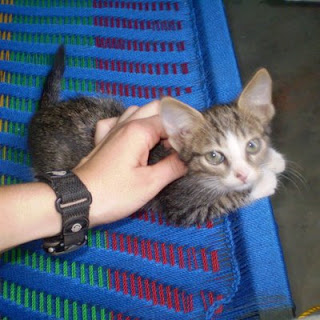
2. I got a kitten! His name is Odysseus (Odie, Oddball, Oddity, etc.) because he gets lost and into trouble all the time. Plus he’s rakishly handsome and dangerously seductive, of course. He’s adorable and is currently sleeping on my lap. Awh!


Currently reading: Reversible Errors by Scott Turow